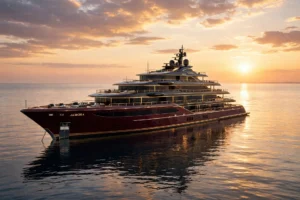
A super yacht for sale in 2026 starts at around $1 million for a small pre-owned 24-metre yacht and runs past €240 million at the top of the market, where the 100.8-metre I Dynasty is currently the most expensive yacht listed for sale anywhere in the world. Between those two numbers sits a market of roughly 1,000 brokerage superyachts, from 30-metre family cruisers to 100-metre-plus floating hotels, and the difference between a good buy and a very expensive mistake is almost always the same thing: knowing what a yacht really costs to own, not just what it costs to buy.
This guide covers the super yachts actually for sale right now, what they cost by size, what it costs to run one, and how to buy safely through a broker.
A super yacht is generally defined as a luxury yacht of 24 metres (about 79 feet) or more, fully crewed and usually custom built. Vessels over 60 metres are often called mega yachts, and those over 100 metres are sometimes called giga yachts. The distinction matters because price, crew and running costs jump at each step, not gradually but in leaps: a 50-metre yacht does not cost twice as much as a 25-metre yacht, it costs five to ten times as much.
| Term | Length | Typical crew | What it means for a buyer |
|---|---|---|---|
| Super yacht | 24–60 m | 4–20 | The main brokerage market; most listings sit here |
| Mega yacht | 60–100 m | 20–35 | Full custom builds, professional crew, marina limits apply |
| Giga yacht | 100 m+ | 35–80 | A handful of yachts, rarely sold, effectively a private ship |
Most buyers searching for a super yacht for sale are looking in the 24 to 50-metre range, where the choice is widest and the running costs are still manageable. That is where this guide spends most of its time.
The top of the market in November 2026 is led by a small group of yachts asking €100 million or more. Every figure below is a published asking price, not a sale price: asking prices are the start of a negotiation, and large yachts routinely sell below asking.
| Yacht | Length | Builder / Year | Asking price | Broker |
|---|---|---|---|---|
| I Dynasty | 100.8 m | Kusch / 2015 | €240,000,000 | Merle Wood & Associates |
| Lady Lara | 91 m | Lurssen / 2015 | €230,000,000 | Merle Wood & Associates, Y.CO |
| Luna | 115 m | Lloyd Werft / 2010 | €200,000,000–€208,000,000 | Eastwind Yachts / Large Yacht Co |
| Energy | 77.8 m | Amels / 2022 | €185,000,000 | Burgess, Fraser |
| Pelorus | 115 m | Lurssen / 2003 | €160,000,000 | Edmiston |
| Vanish | 71.5 m | Feadship / 2021 | €148,000,000 | Burgess, Feadship Resale |
| Boardwalk V | 76.5 m | Feadship / 2021 | €135,000,000 | Burgess, Y.CO |
| Synthesis | 74 m | Amels / 2021 | €132,000,000 | Burgess, Torrance Yachts |
I Dynasty: €240 million. The most expensive super yacht for sale in the world right now. The 100.8-metre Kusch build was delivered in 2015 and was the German yard’s second-largest yacht, behind only the 133.2-metre Al Mirqab. At that price she is not really competing with other yachts; she is competing with the handful of new builds a buyer could commission instead.
Lady Lara: €230 million. A 91-metre Lurssen delivered in 2015, on the market since September 2023, the first time she has been offered for sale since delivery. Lurssen is the builder behind most of the world’s largest yachts, and a ten-year-old Lurssen in good condition is one of the safest large purchases in the market.
Luna: €200–208 million. A 115-metre yacht from Lloyd Werft, a World Superyacht Awards winner inspired by a hammerhead shark, with a mast modelled on a dorsal fin. Two brokers list her at slightly different prices, which is common at this level: always confirm the current asking price with the listing broker before treating any figure as final.
Energy: €185 million. A 77.8-metre Amels delivered in 2022, one of the newest yachts in the top ten. She shows the other side of the market: a nearly new yacht from a top Dutch yard can ask almost as much as a much larger, older one, because age and condition matter as much as length.
Pelorus: €160 million. A 115-metre Lurssen from 2003, delivered as the 11th-largest superyacht in the world and the largest yacht Lurssen had built at the time. She is the reminder that a great hull from a great yard holds value for decades, but also that a 20-year-old yacht of this size carries refit costs a buyer must budget for.
For the full list, see BOAT International’s 50 most expensive yachts for sale now, updated in November 2026.
Below the headline yachts, prices fall into clear bands by size. The figures are 2026 market ranges for new builds and brokerage yachts, and they show how steeply the price climbs with length.
| Size | New build | Pre-owned | Typical crew |
|---|---|---|---|
| 24–30 m | $3–15 million | $1–8 million | 4–6 |
| 30–40 m | $8–25 million | $2–15 million | 6–9 |
| 40–50 m | $15–50 million | $5–30 million | 8–12 |
| 50–70 m | $25–80 million | $8–50 million | 12–20 |
| 70–100 m | $60–200 million | $25–100 million | 20–35 |
| 100 m+ | $150–500 million+ | $80–300 million+ | 35–80 |
A 50-metre semi-custom Benetti starts at approximately €25 million, while a 50-metre fully custom Feadship will exceed €50 million. A fully custom new build is often estimated at around $1 million per 3.3 feet of length, and a 100-metre-plus custom yacht takes four to six years from contract to delivery.
The brokerage market offers a different value proposition. A five-year-old superyacht from a top-tier builder will typically sell for 40 to 65 percent of its original new-build cost, a reflection of depreciation, newer inventory, and the buyer’s need to survey and possibly refit. Early 2026 pricing reflects a market correction from the pandemic-era peak of 2021–2022, when demand outstripped supply and vessels sold within days at or above asking price. Buyers in 2026 have more room to negotiate than they have had in years.
The purchase price is the entry fee; the running costs are the membership. The market’s long-standing rule is to budget about 10 percent of the yacht’s value per year, and for the largest yachts the real figure is higher: 12 to 15 percent above 50 metres, and 15 to 20 percent above 80 metres. Some managers put the honest range at 7 to 12 percent of the original new-build price, climbing as the vessel ages.
| Annual cost | Example: $20 million yacht | Example: $50 million yacht |
|---|---|---|
| Crew salaries and benefits | $800,000–$1 million | $2–3 million |
| Maintenance and repair | $300,000–$400,000 | $750,000–$1.5 million |
| Fuel | $200,000–$300,000 | $500,000–$1 million |
| Insurance | $160,000–$200,000 | $400,000–$500,000 |
Crew is the biggest line, at 30 to 45 percent of the annual total. A 50-metre yacht usually employs 10 to 12 crew at $1 million to $2 million a year in salaries alone. A 30-metre yacht costs roughly $670,000 to $1.2 million a year to run, a 50-metre yacht $2.3 million to $4.1 million, and an 80-metre yacht $5 million to $9 million.
Insurance typically runs 0.5 to 1.5 percent of the agreed hull value a year. Berthing varies sharply by location: a summer berth in the western Mediterranean costs far more than a winter berth elsewhere, and utilities can add 20 to 30 percent on top. Management fees run roughly €36,000 to €96,000 a year for a 30 to 50-metre yacht.
Yachts also depreciate. The first year typically sees the largest adjustment, often around 10 percent, and after that depreciation settles at roughly 6 to 8 percent a year. A pre-owned yacht costs less to buy but the same to run, because running costs follow the yacht’s size and original build, not the price paid.
Buying new gives you a yacht built around your own programme, a full warranty, and the exact layout you want. The price is the highest, the wait is three to six years, and the boat loses the most value in its first year.
Buying used is how most first-time superyacht buyers get in. A two or three year old yacht can cost 20 to 40 percent less than new, with most of its life still ahead of it. The risk is condition: a badly kept yacht hides very expensive problems, and at this size there are far more systems to check than on a smaller boat.
For a used super yacht, five checks matter most. First, a full out-of-water survey by a surveyor who knows large yachts, including a hull and machinery inspection. Second, the maintenance and refit history: a yacht due a major refit is not the bargain it looks like. Third, engine hours and service records for every engine and generator. Fourth, the crew: a good captain and chief engineer who know the boat are worth more than any discount. Fifth, a sea trial in real conditions, so you can feel how the yacht handles and hear how the machinery runs.
If a seller will not allow a survey or a sea trial, walk away. There is always another yacht.
First, define your programme honestly. Write down how many people usually cruise with you, where you will cruise, and whether the yacht is for private use, charter income, or both. A 50-metre yacht bought for weekend sailing that mostly carries four people is the wrong boat.
Second, choose new or used. If you want the yacht built around you and can wait three to six years, commission a new build. If you want to cruise next season, buy used and spend the saving on the refit.
Third, set a real budget. Include the purchase price, tax, delivery, insurance, berthing, and at least a year of running costs at 10 percent of the yacht’s value. If the total is more than you are comfortable with, drop down one size rather than stretching.
Fourth, shortlist two or three yachts, not ten. Go aboard them if you can. An interior layout you do not enjoy is a very expensive mistake, and you will spend far more time in the saloon than on the helm.
Fifth, hire a buyer’s broker and a surveyor, and use both. The broker negotiates and checks the paperwork; the surveyor checks the boat. Neither works for the seller. A good buyer’s broker costs you nothing directly, as the commission is usually paid from the seller’s side, and the saving they negotiate usually covers their fee many times over.
Sixth, check the paperwork properly. Registration, VAT or tax status, number of owners, damage history, and whether the yacht has any outstanding finance. Get insurance quotes before you commit, not after, because quotes vary a lot between yacht models and cruising areas.
If you are still deciding which yacht fits you, browse the current yachts for sale on Zonezi and compare real yachts side by side, with prices, specifications, and layouts.
What is a super yacht?
A luxury yacht of 24 metres (about 79 feet) or more, fully crewed and usually custom built. Yachts over 60 metres are often called mega yachts, and those over 100 metres are sometimes called giga yachts.
How much does a super yacht cost?
From around $1 million pre-owned for a small 24-metre yacht to more than €240 million for the most expensive yacht currently for sale, the 100.8-metre I Dynasty. A typical 30 to 40-metre pre-owned superyacht costs $2 million to $15 million, and a 50-metre yacht costs $8 million to $50 million pre-owned.
What is the most expensive super yacht for sale right now?
I Dynasty, a 100.8-metre Kusch yacht delivered in 2015, asking €240 million with Merle Wood & Associates. Lady Lara follows at €230 million and Luna at around €200 million.
How much does it cost to run a super yacht per year?
Budget about 10 percent of the yacht’s value per year, rising to 12 to 15 percent above 50 metres. A 30-metre yacht costs roughly $670,000 to $1.2 million a year to run, a 50-metre yacht $2.3 million to $4.1 million, and an 80-metre yacht $5 million to $9 million. Crew is the largest cost, at 30 to 45 percent of the total.
Is it better to buy a new or used super yacht?
Used is how most first-time buyers get in: a two or three year old yacht can cost 20 to 40 percent less than new. New makes sense only if you want the yacht built around you and can wait three to six years. Either way, get a full survey and a sea trial before you pay.
Do I need a broker to buy a super yacht?
You are not legally required to use one, but you should. A buyer’s broker negotiates the price, checks the paperwork and the yacht’s history, and usually costs you nothing directly, as the commission is paid from the seller’s side. Never rely on the seller’s broker alone.
A super yacht for sale in 2026 starts at around $1 million and runs past €240 million, with the widest choice in the 24 to 50-metre range. The most expensive yachts on the market right now are I Dynasty at €240 million, Lady Lara at €230 million and Luna at around €200 million, but the real market for most buyers is a 30 to 50-metre yacht at $2 million to $50 million pre-owned.
The price is only the start. Allow 10 percent of the yacht’s value per year to run it, and 12 to 15 percent above 50 metres, and remember that a pre-owned yacht costs less to buy but the same to run. Define your programme, survey before you pay, and prefer yachts with complete records. If you are ready to look, start with the yachts for sale on Zonezi and see what is available right now.