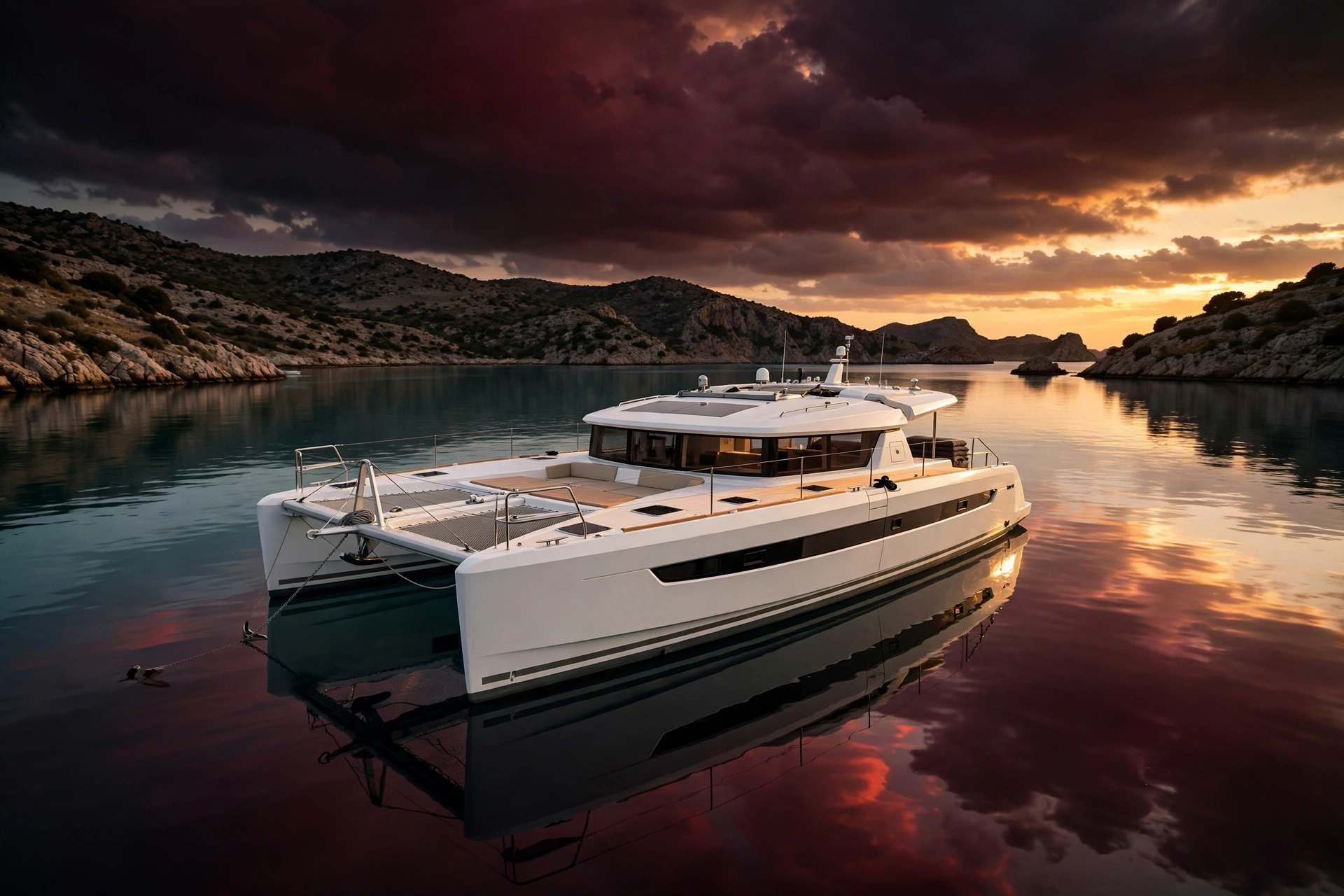
A catamaran for sale is not one boat. It is a whole market, from a $150,000 used 38-footer that sleeps a family to a $6.9 million Sunreef 60 with a flybridge and a range that crosses oceans. The right catamaran depends on how many people you sail with, where you sail, and whether you want a floating home, a charter business, or both.
This guide explains what a catamaran is, the best models for sale in 2026, what they cost new and used, what they cost to run, and how to buy one safely.
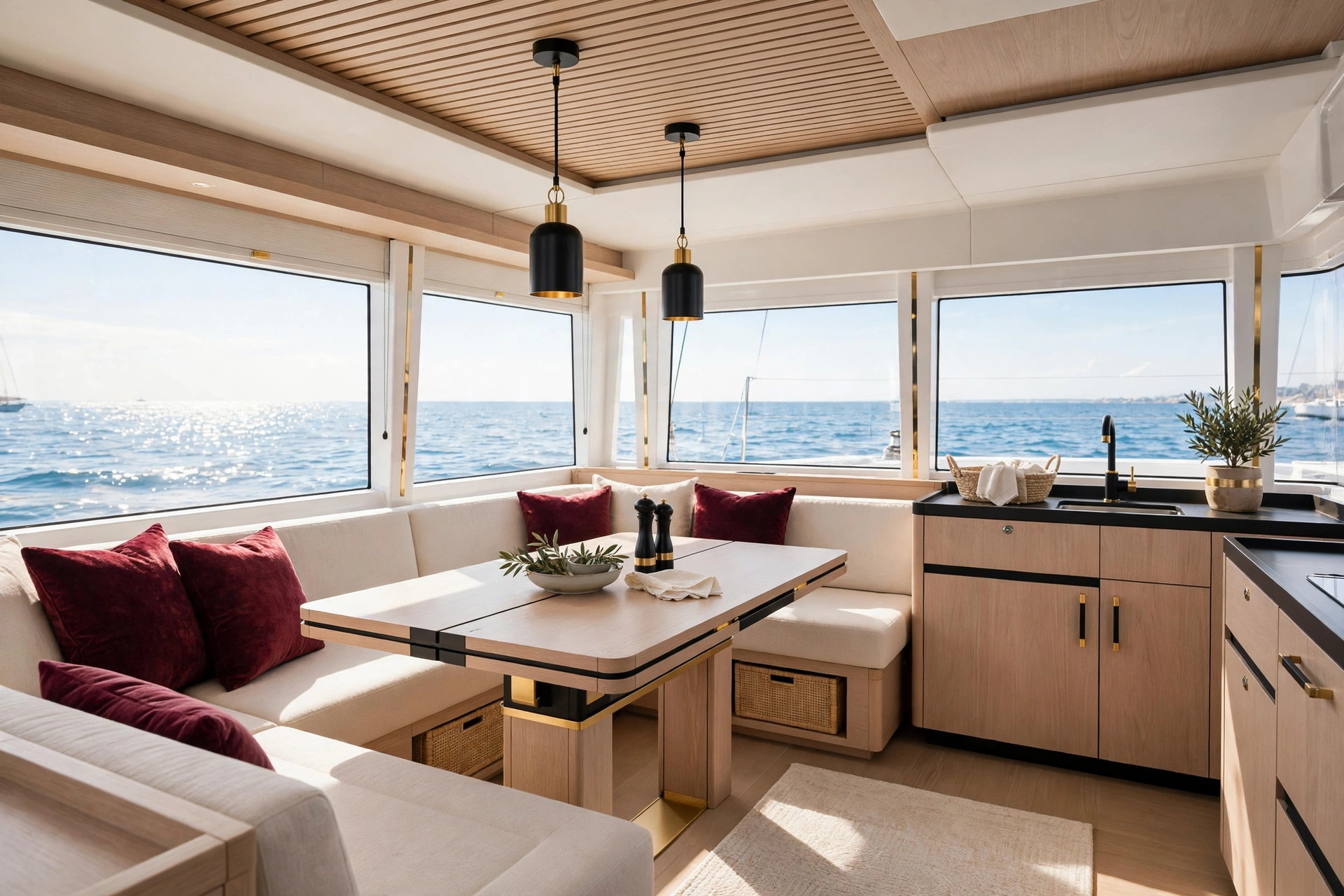
A catamaran is a boat with two hulls joined by a bridgedeck, instead of the single hull of a monohull. The saloon sits on the bridgedeck between the hulls, which is why a 45-foot catamaran feels far roomier than a 45-foot monohull: the living space spans the full width of the boat. The twin-hull design barely heels, so the deck stays level; it draws only 1.2 to 1.4 metres at 40 feet, so you can anchor close to beaches other boats cannot reach; and the cabins sit in separate hulls, giving two couples real privacy.
| Feature | Catamaran | Monohull |
|---|---|---|
| Stability | Stays almost level, very little heeling | Heels under sail, rolls at anchor |
| Living space | Wide saloon spans both hulls, 4 cabins common at 45 ft | Narrower saloon, usually 2 to 3 cabins at 45 ft |
| Draft | Shallow, around 1.2 to 1.4 m at 40 ft | Deeper, typically 1.8 to 2.2 m at 40 ft |
| Speed under sail | Faster on a reach, similar upwind | Faster pointing into the wind |
| Marina cost | Wider berth, fees often 20 to 50% higher | Standard berth, lower fees |
| Maintenance | Two engines, two hulls to antifoul | One engine, one hull |
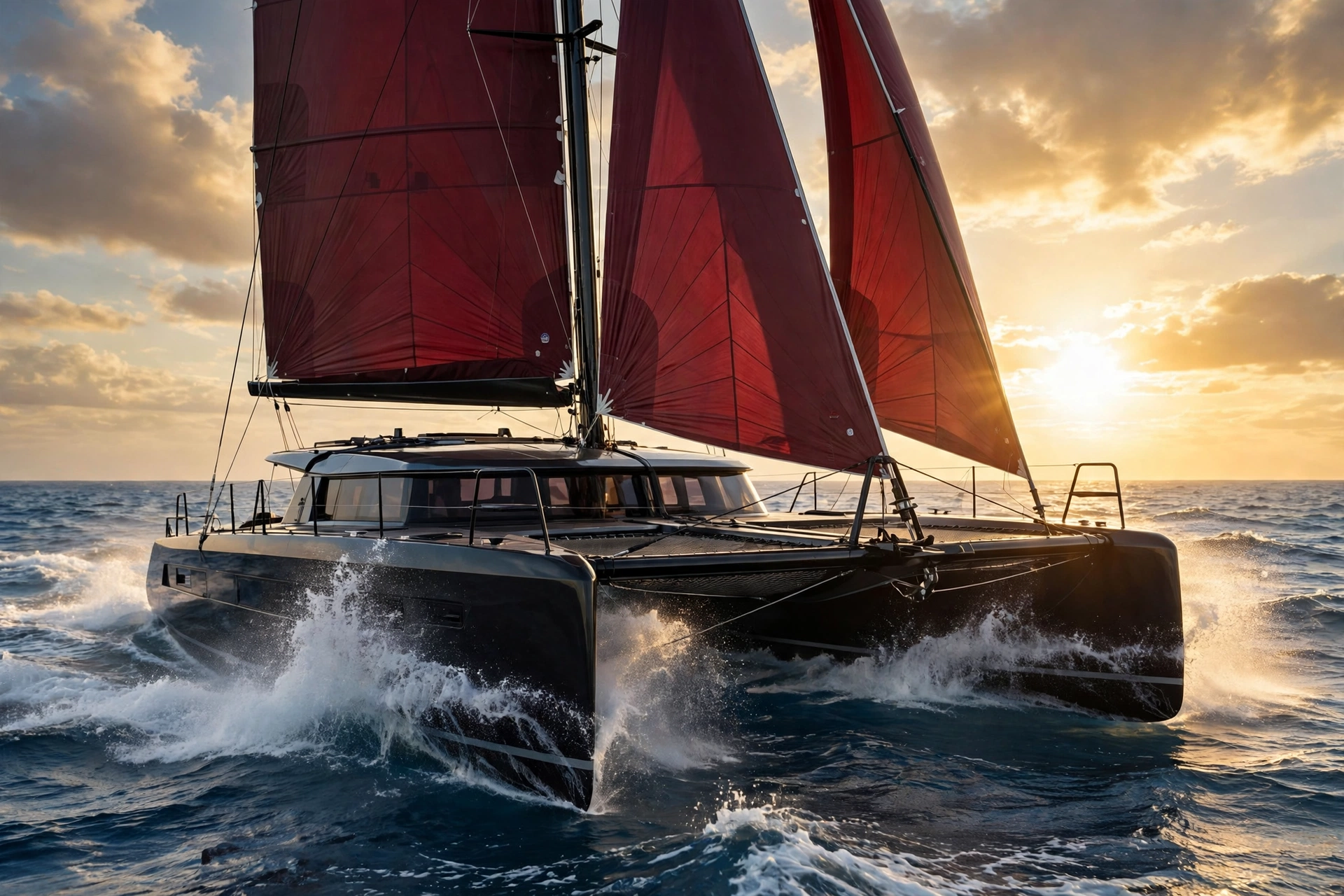
The trade-off is honest: a catamaran costs more to berth and maintain than a monohull of the same length, and it needs a wider slip. What you get for that money is space, stability and a shallow draft that opens up anchorages a monohull cannot use. Catamarans come in two kinds: a sailing catamaran is driven by wind, with two small diesel engines for harbours and calm days, while a power catamaran has no mast or sails and runs on two larger engines, trading wind power for speed and simplicity. Most buyers looking for a catamaran for sale are looking at sailing cats, and this guide focuses on them.
Three brands dominate production output and brokerage liquidity: Lagoon, Fountaine Pajot and Leopard. Together they build most of the cruising catamarans sold in the world, which also means the widest choice of used boats and the strongest resale values. These are the standout models for sale in 2026, from the entry level to the luxury tier, with new prices from the 2026 price lists.
| Model | Price from (new) | Length | Why it stands out |
|---|---|---|---|
| Fountaine Pajot Astréa 42 | $430,000 | 42 ft | The cheapest new premium catamaran: elegant French finish, 3 to 4 cabins, real offshore pedigree. |
| Lagoon 40 | $450,000 | 40.6 ft | The best-selling catamaran layout in the world: huge cockpit, easy short-handed handling, deepest used market of any cat. |
| Leopard 45 | $480,000 | 45 ft | Built by Robertson and Caine in South Africa. The most charter-proven catamaran on the market, and one of the best at holding value. |
| Fountaine Pajot Elba 45 | $500,000 | 45 ft | More performance-oriented than the Lagoon 46, with the same 4-cabin comfort and a lighter, faster hull. |
| Lagoon 46 | $600,000 | 46.1 ft | The family sweet spot: four cabins, a flybridge option, the model most charter fleets buy first. |
| Lagoon 51 | $850,000 | 51.7 ft | A step up in space and presence: 4 to 5 cabins and a saloon that seats twelve. |
| Leopard 58 | $1.1M | 58 ft | Four cabins at superyacht scale, with a flybridge built for long passages and charter income. |
| Lagoon 55 | $1.7M | 55 ft | Lagoon’s near-flagship: a huge flybridge and build quality that feels like a custom yacht. |
| Sunreef 60 | $5.2M | 59 ft | Polish-built luxury in a class of its own, with solar-integrated and fully electric options. |
Lagoon holds roughly 60 percent of the production cruising catamaran market by volume, which is why a used Lagoon is the easiest catamaran in the world to resell. Fountaine Pajot sits slightly upmarket on finish and sailing performance and commands a 5 to 15 percent premium over volume-tier equivalents. Leopard is the charter fleet favourite: if you plan to put your boat into a charter management programme when you are not using it, a Leopard is the safest choice for income and resale.
New catamaran prices fall into clear bands, and knowing them saves you from wasting time on boats outside your budget.
The entry band runs from around $100,000 to $250,000. This is the used market for 35 to 40-foot boats: older Lagoon 380s and 400s, Leopard 38s and Fountaine Pajot Liparis, typically 10 to 20 years old. A 10-year-old 40-footer usually sells for $180,000 to $450,000 depending on condition and equipment.
The mid-range band runs from around $250,000 to $700,000. This is where most buyers land: newer used boats in the 40 to 50-foot class, or a five-year-old 45-footer at $450,000 to $700,000. A new 45-foot catamaran from a top manufacturer starts around $500,000 to $800,000 in 2026.
The large new band runs from around $850,000 to $2.6 million: the Lagoon 51 from $850,000, the Leopard 58 from $1.1 million, and the Lagoon 55 from $1.7 million. A new 60-foot catamaran typically runs $2 million to $3.5 million, and premium or superyacht catamarans of 65 feet and over run from $3 million to $15 million and beyond. For a second opinion on these numbers, see Catamarans.com’s 2026 catamaran price guide.
Used prices follow the same curve. A five-year-old 45-footer in the volume tier sells for roughly $450,000 to $600,000 as an ex-charter boat and $550,000 to $700,000 as an owner version, while the same boat in the premium tier, Fountaine Pajot or Nautitech, sells for roughly $500,000 to $680,000. Catamarans hold their value better than monohulls of the same age, largely because charter demand keeps the used market liquid.
The purchase price is only the start. A catamaran costs more to keep than a monohull of the same length, and buyers who ignore that get an unpleasant surprise in the first year.
The widely used rule is to budget 5 to 10 percent of the boat’s value per year for running costs, before financing. For a 40-foot catamaran that works out at roughly $30,000 to $65,000 a year, depending on where you keep it and how much maintenance you do yourself. For a $700,000 catamaran, a conservative annual budget is maintenance $20,000 to $40,000, dockage $10,000 to $20,000, and insurance $4,000 to $6,000, for a total of $34,000 to $66,000 or more.
Marina fees are the cost that surprises new owners most. A catamaran needs a wider berth than a monohull, and many marinas charge 20 to 50 percent more for it. Annual dockage for a 45-foot catamaran in a premium Mediterranean or Caribbean marina runs $12,000 to $25,000 a year, while the same boat in a cheaper marina can cost far less. Insurance typically runs 0.7 to 1.5 percent of the insured value per year, so $3,000 to $8,000 a year on a 40-foot boat. Bluewater cruising cover and boats kept in hurricane zones push premiums higher.
Then there are the replacement cycles. Sails last 5 to 8 years and cost $10,000 to $30,000 to replace on a larger catamaran. Standing rigging lasts 7 to 10 years. Engines run 5,000 to 8,000 hours before a major overhaul. Fuel is modest on a sailing catamaran: a twin-diesel setup burns roughly 30 litres an hour in total at cruising speed, and sailors who prioritise sailing over motoring often keep fuel to $2,000 to $4,000 a year.
Buying new gives you a full warranty, the exact layout you want, and no hidden history. The price is the highest, and the boat will lose value fastest in the first year or two, though catamarans depreciate more gently than monohulls.
Buying used is how most first-time catamaran buyers get in. A two or three year old catamaran can cost 20 to 40 percent less than new, with most of its life still ahead of it. The risk is condition: a badly kept catamaran can hide very expensive problems, and there are two hulls, two engines and twice the rigging to check.
For a used catamaran, five checks matter most. First, a full out-of-water survey by a surveyor who knows multihulls, including a moisture and osmosis check on both hulls. Second, the age of the sails and standing rigging: a boat due a $20,000 sail replacement is not the bargain it looks like. Third, engine hours and service history on both engines, not just one. Fourth, charter history: ex-charter boats are cheaper but have been sailed hard by many crews, so check the interior and electronics harder. Fifth, a sea trial in real wind, so you can feel how the boat sails.
If a seller will not allow a survey or a sea trial, walk away. There is always another catamaran.
Buying a catamaran is exciting, and it is also where most mistakes happen. Follow these steps in order.
First, define your mission honestly. Write down how many people usually sail with you, where you will sail, and whether you will live aboard, cruise part-time, or charter the boat out. A 40-footer bought for weekend sailing that mostly carries eight people is the wrong boat.
Second, choose sailing or power. If you love sailing and want low fuel costs, buy a sailing catamaran. If you want speed and simplicity and accept higher fuel bills, look at a power catamaran.
Third, set a real budget. Include the purchase price, tax, delivery, insurance, berthing, and at least a year of running costs at 5 to 10 percent of the boat’s value. If the total is more than you are comfortable with, drop down one size rather than stretching.
Fourth, shortlist two or three models, not ten. Sail on them if you can. A saloon layout you do not enjoy is a very expensive mistake, and you will spend far more time in the saloon than on the helm.
Fifth, get a survey and a sea trial from an independent surveyor who knows multihulls, every time, even from a main dealer. The survey commonly costs a few thousand dollars and can save you tens of thousands.
Sixth, check the paperwork properly. Registration, VAT or tax status, number of owners, damage history, and whether the boat has any outstanding finance. Get insurance quotes before you commit, not after, because quotes vary a lot between catamaran models and cruising areas.
If you are still deciding which catamaran fits you, browse the current yachts for sale on Zonezi and compare real catamarans side by side, with prices, specifications, and layouts.
Q: What is the cheapest catamaran for sale?
A: Used 35 to 40-foot catamarans start from around $100,000 to $250,000, for older Lagoon, Leopard and Fountaine Pajot models. The cheapest new catamaran from a major builder is the Fountaine Pajot Astréa 42, from around $430,000.
Q: How much does it cost to run a catamaran per year?
A: Budget 5 to 10 percent of the boat’s value per year. A 40-foot catamaran costs roughly $30,000 to $65,000 a year, including marina fees, insurance, maintenance and fuel. A $700,000 catamaran runs roughly $34,000 to $66,000 a year or more.
Q: What is the best catamaran to buy in 2026?
A: For a first catamaran, the Lagoon 40 is the benchmark: best-selling layout, huge used market, and easy to resell. The Fountaine Pajot Astréa 42 is the cheapest new premium option, and the Leopard 45 is the pick if you plan to charter the boat out.
Q: Is it better to buy a sailing catamaran or a power catamaran?
A: A sailing catamaran costs far less to run and can cross oceans on wind power, but it is slower and needs sails and rigging maintained. A power catamaran is faster and simpler, with no rigging, but burns much more fuel. Most buyers choose sailing cats, and the used market for them is far deeper.
Q: Do catamarans hold their value?
A: Better than monohulls of the same age. Strong charter demand keeps the used market liquid, and the big three brands, Lagoon, Fountaine Pajot and Leopard, hold value best. Ex-charter boats depreciate faster than owner versions. No boat should be bought purely as an investment.
Q: Should I buy a catamaran or just charter one first?
A: Charter first. A bareboat week on a 40 to 45-foot catamaran in the Caribbean costs roughly $6,000 to $14,000 in peak season, and it will teach you more about what size and layout you actually want than months of reading. If you still want your own boat after a week aboard, you will buy the right one.
A catamaran for sale in 2026 runs from around $100,000 used to $6.9 million for a Sunreef 60, with the Lagoon 40, Fountaine Pajot Astréa 42 and Leopard 45 in between as realistic first catamarans at $430,000 to $580,000 new. The purchase price is only the start: allow 5 to 10 percent of the boat’s value per year to run it, and remember the berth costs more than a monohull’s.
Define your mission, choose sailing or power, survey before you pay, and prefer boats with complete records. If you are ready to look, start with the yachts for sale on Zonezi and see what is available right now.