
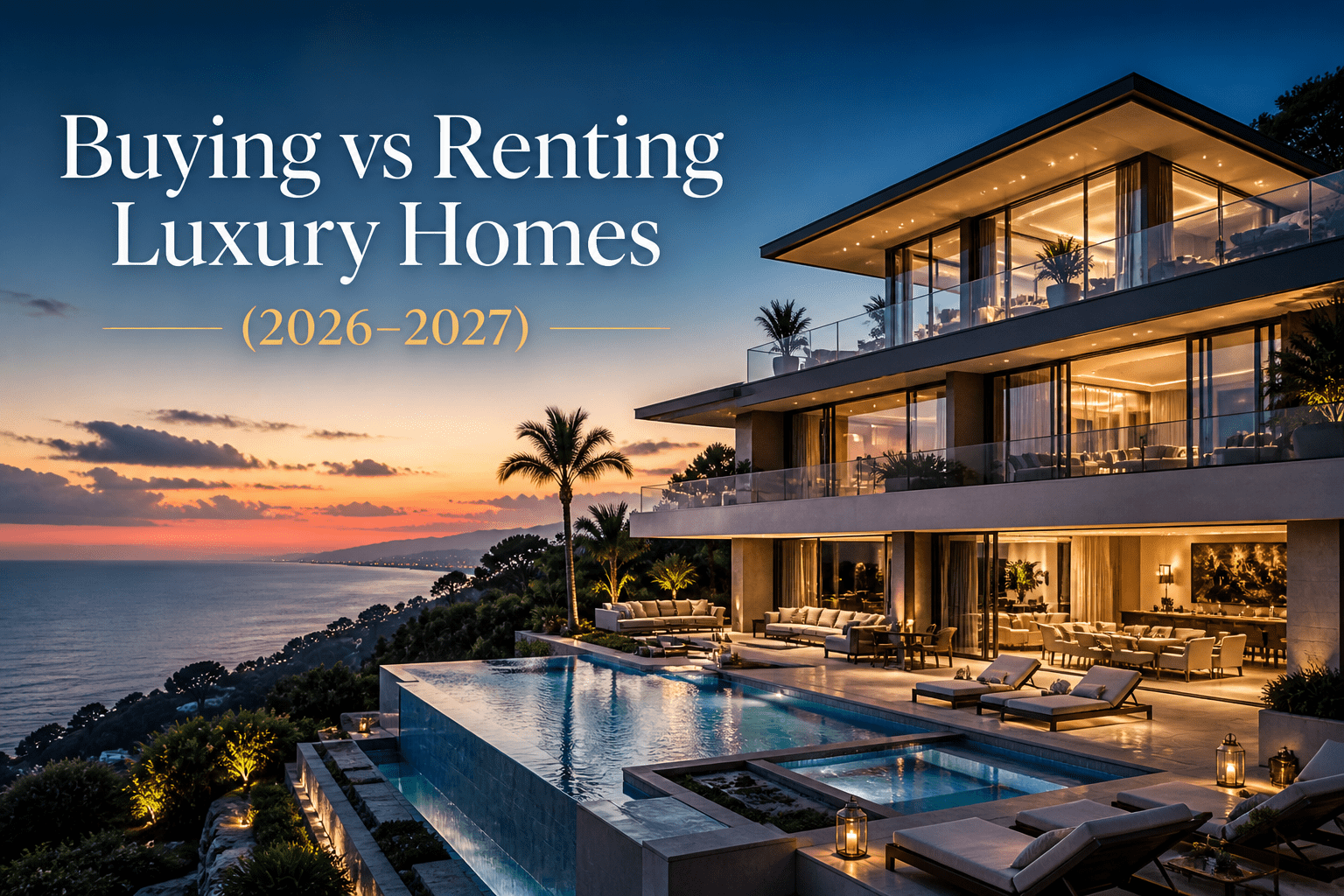
In 2026 and moving into 2027, affluent individuals, global investors, entrepreneurs, and second-home buyers are approaching real estate with a far more strategic mindset. The conversation is no longer centered solely on location, architecture, or prestige. Instead, a more profound question dominates the luxury market:
Is it wiser to buy a luxury home, or does renting create greater financial flexibility and long-term advantage?
Across elite destinations such as Dubai, London, Miami, Phuket, and Singapore, the luxury residential sector continues to attract international capital. Yet the motivations behind acquisitions have evolved. High-net-worth individuals are increasingly analyzing tax efficiency, jurisdictional stability, long-term liquidity, wealth preservation, and lifestyle alignment before committing substantial capital.
According to official research from Knight Frank and Savills, prime residential markets remain resilient, supported by wealth migration, constrained inventory, and continued demand from globally mobile investors.
For those considering luxury real estate in 2026–2027, understanding the advantages and limitations of both buying and renting has never been more essential.
Luxury real estate ownership has historically served as one of the most effective methods of preserving wealth while enjoying lifestyle benefits.
When purchasing a premium residence, buyers are not merely acquiring a home. They are often securing a tangible asset in a market where land scarcity, exclusivity, and global desirability continue to support long-term value.
Prime residential districts remain attractive because they offer something financial markets cannot always provide: physical scarcity.
Whether it is a beachfront villa in Phuket, a penthouse overlooking the skyline of Dubai, or a branded residence in Miami, ownership creates a sense of permanence and portfolio diversification.
According to official market intelligence from Knight Frank, prime residential values in leading global luxury destinations remained stable to positive throughout recent market cycles, supported by continued demand from international wealth migration.
One of the greatest advantages of buying is equity accumulation.
Each payment made toward a financed luxury property contributes toward ownership rather than being treated as a pure expense. Over time, owners may benefit from:
Capital appreciation
Asset-backed borrowing opportunities
Estate and succession planning
Portfolio diversification
Currency and inflation protection
For ultra-high-net-worth individuals, luxury real estate increasingly functions as a strategic balance-sheet asset rather than simply a personal residence.
Another factor supporting ownership in 2026–2027 is limited supply.
In many global prime locations, development opportunities remain restricted due to zoning regulations, environmental limitations, and waterfront scarcity. This creates a structural imbalance between supply and demand, helping support long-term valuations.
Despite the prestige and wealth-building potential, buying luxury real estate is not without its challenges.
Luxury acquisitions typically involve significant upfront capital requirements.
Beyond the purchase price itself, buyers often face:
Legal due diligence
Transfer taxes
Stamp duties
Registration fees
Property structuring costs
Insurance expenses
Maintenance and staffing costs
In some jurisdictions, acquisition costs alone can reach hundreds of thousands of dollars.
Liquidity is another important consideration.
Unlike publicly traded securities, luxury homes cannot always be sold quickly. Even in highly desirable markets, a multimillion-dollar residence may require patience, negotiation, and proper timing to secure the right buyer.
This becomes especially relevant during periods of regulatory change, currency volatility, or shifts in international investment flows.
For many successful entrepreneurs, investors, and international executives, renting luxury property is no longer viewed as a compromise.
In fact, in 2026, renting has become a deliberate wealth strategy.
One of the most significant advantages is capital preservation.
Rather than allocating millions toward a single real estate acquisition, renters retain liquidity that can be deployed into:
Private equity
Operating businesses
Stock markets
Technology investments
Alternative assets
For individuals who prioritize growth, flexibility, or business expansion, maintaining access to liquid capital may create stronger financial outcomes than tying up funds in a residential asset.
Another major advantage is geographic freedom.
Today’s wealth creators are increasingly global.
Many split their time between Dubai, Singapore, London, Bangkok, and other financial centers throughout the year.
Renting allows them to maintain premium living standards without becoming tied to a single jurisdiction.
It also eliminates many ownership responsibilities, such as:
Major structural repairs
Capital upgrades
Long-term building maintenance
Administrative property management
For second-home users, digital entrepreneurs, or international executives, this convenience carries enormous value.
Despite its flexibility, renting also presents limitations.
The most obvious is the absence of equity.
Monthly rental payments create lifestyle access, but they do not generate ownership or long-term capital accumulation.
In appreciating markets, renters may also face rising lease renewals, reduced negotiating power, and the possibility of being priced out of elite neighborhoods over time.
Customization can also be restricted.
Luxury tenants often have limited freedom to make permanent architectural or design changes, which may reduce the emotional connection many affluent buyers seek from their residences.
For those who value legacy, personalization, or long-term family planning, renting may feel transactional rather than meaningful.
Several macroeconomic and lifestyle trends are shaping luxury housing decisions.
Wealth migration continues to influence global property demand, with buyers relocating toward tax-efficient and internationally connected destinations such as Dubai, Singapore, Portugal, and Thailand.
Lifestyle priorities have also shifted dramatically.
Today’s luxury buyers increasingly prioritize:
Wellness amenities
Private security
Marina access
Smart-home integration
Branded residences
Multi-generational living spaces
These preferences are reshaping the luxury market across both urban and resort destinations.
Buying luxury property may be the superior choice if your goals include:
Long-term wealth preservation
Building equity
Creating a family legacy
Diversifying your portfolio
Securing residency or relocation opportunities
Renting luxury property may be the smarter decision if your priorities include:
Global mobility
Business expansion
Maintaining liquidity
Reducing operational responsibilities
Testing new markets before purchasing
The most sophisticated investors in 2026–2027 are no longer asking whether they can afford luxury real estate.
They are asking a far more intelligent question:
Does this decision strengthen my wealth, improve my lifestyle, and enhance my long-term optionality?
In the right market, buying can create extraordinary generational value.
In the right circumstances, renting can preserve agility and unlock superior financial opportunities.
Ultimately, the correct decision is not emotional. It is strategic.
At ZONEZI, brokers gain access to a curated portfolio of premium listings, while private owners enjoy unparalleled visibility within a global network of discerning buyers. We are committed to facilitating successful transactions in the world of luxury, driving growth, and creating valuable opportunities in the marketplace.