Opinion: Why investing in Phuket makes good sense
Panupong Kritchanarat, originally from Bangkok, is currently the CEO of Boat Pattana, Phuket and has been working with its management for eight years. He also has several years of experience in real estate management. He holds a Masters of Business Administration from the Sasin Graduate Institute of Business Administration at Chulalongkorn University.

Here, he talks about business options in Phuket and why it is a good place to invest.

Prime Minister Gen Prayuth Chan-o-cha officially visited Phuket last month in order to chair the grand opening ceremony of the new airport terminal, as well as Startup Thailand and Digital Thailand 2016. His visit was interesting to both Thais and foreigners, as many wondered why he was paying this much attention to Phuket, and especially why he flew down here himself.

The answer is simple. Startup Thailand is one of the countryโ€™s most important strategic ventures. It is a mega-trend that people worldwide are interested in. The Thai government has shown great vision by investing in this field. Gen Prayuth even flew to China to meet and discuss the future prospects of Startup Thailand with Jack Ma, the Chairman of Alibaba Group.

Most people I interact with say they want a house in a tourist province such as Phuket, whether they are investors, businessmen or otherwise. While others ask me what is so special about living in Phuket or owning property for investment purposes. Here is what I have to say to them.

What makes Phuket outstanding as compared to other cities, both in Thailand and abroad, are the beautiful beaches. This is why Hollywood celebrities regularly fly to Phuket for their holidays.

In addition, local people are very kind and people in Phuket speak in English, more than most people in the rest of Thailand. Besides the beautiful beaches, Phuket has also been named as a City of Gastronomy by UNESCO. Additionally, the cost of living is not high when compared to other tourist destinations in the world. Moreover, there are two other neighboring provinces that are also beautiful, which makes it an ideal location to travel to.

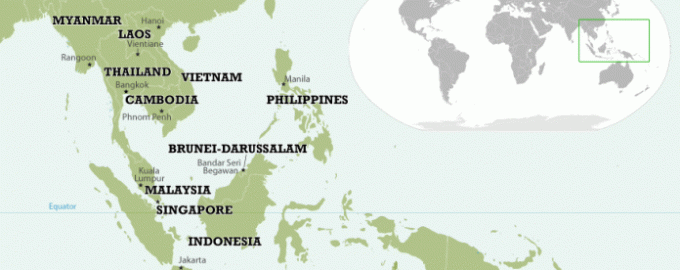
Phuket is located in the hottest region at the moment. While other countries are trying to keep their economies from falling apart, Asian countries are prospering, particularly those in the Asean Economic Community. There are many foreigners living in Phuket for that very reason. Many families have settled here, or their kids study here while one or both parents work in China, Hong Kong, Singapore, Vietnam or Indonesia.

Phuket has an international airport that is able to support thousands of passengers. Because of the close proximity to Phang Nga, it is easy to deliver supplies to the island, either by land or boat. Phuket is one of the marina hubs in Asia and has caught the attention of millionaires around the world. This is our strongest selling point. We also have experts in yacht maintenance as well as luxury hotels, spas and good food.

Phuket is also on its way to becoming a medical and healthcare hub. We have affordable aesthetic and beauty treatments, and excellent service during and after treatment.

Phuket has several Thai and international schools providing a high standard of education. The culture of these schools is becoming increasingly global, which helps students think outside of the box. So it is an ideal place to start a family.

Phuket is expanding, but one of the problems we face is limited land supply. The only way to expand further is into the sea, Therefore land prices in Phuket are going up rapidly.

Phuket people are capable of moving the island forward. They donโ€™t sit around waiting for the government or anybody else to step in. There are many young and enterprising investors in Phuket, who have a great vision for improving the island and helping it keep up with the rest of the country and the world.


15/02/2019No commentsApartment|Business Development|Houzez|Luxury|Real Estate
Thailand takes steps to boost FDI

Tax exemptions and other incentives are set to spearhead Thailandโ€™s efforts to boost foreign direct investment (FDI) in targeted areas of the economy.

The initiatives form part of a broader range of incentives and reforms aimed at increasing capital inflows into Thailand, with a particular focus on tapping investment for planned industrial clusters in the eastern economic corridor (EEC) project, an initiative of the public-private Pracha Rath scheme.

However, while efforts to stabilise the Thai economy are beginning to yield results, challenges, such as lower external demand and political uncertainty, remain a concern.

Tapping key markets

Speaking during a visit to China at the end of June, Somkid Jatusripitak, Thailandโ€™s deputy prime minister, said the governmentโ€™s new incentives and support package would be implemented in the third quarter of 2016.

Somkid was in China to highlight the opportunities for investors in the special industrial zones located throughout the EEC, which encompasses the provinces of Chon Buri, Rayong and Chachoengsao.

โ€œThe government is transforming the economy to a higher level,โ€ Somkid told investors. โ€œDuring this period of change, we need more investment from outside โ€“ and China is one of the targets.โ€

Planned incentives include corporate and personal income tax privileges beyond those already provided by Thailandโ€™s Board of Investment (BoI), Somkid said. ย The raft of incentives will be bolstered by regulatory and legislative reforms aimed at improving the laws governing industrial management, financial services and investment.

The government has also said it would provide approximately 4160 ha of land as well as key infrastructure, such as the East-West ferry development project, to develop and support dedicated industrial estates โ€“ biotech, biofuel, aviation, IT and digital, medicine and medical equipment ยญโ€“ throughout the EEC, with an expected total investment of between $55bn and $58bn, according to local media reports.

Thailand is also keen to boost capital inflows from India. During a visit to the country in mid-June, Thailandโ€™s Prime Minister Prayut Chan-o-cha said the government planned to introduce measures aimed at facilitating the flow of investment from India. He also highlighted the importance of speeding up negotiations on a free trade agreement between the two countries.

Targeted investment

While Thailandโ€™s government is still finalising its incentive package, the government has already announced several measures aimed at attracting businesses.

In late June the revenue department announced plans to offer foreign experts operating in key fields tax exemptions for terms of between 10 to 15 years. The proposed waiver is scheduled to come into force in 2017, although details have yet to be made public.

The BoI, meanwhile, approved a personal income tax cut for foreign researchers and experts working in targeted industry clusters. The sectors, which are viewed by the government as key drivers of growth include: next-generation cars, smart electronics, logistics and aviation, biofuels and biochemical, and industrial robotics, among others.

In a similar move, the Cabinet signed off on a proposal at the end of May to double tax breaks for investors who launch or break ground on a new project in 2016.

Tackling shortfalls

Thailand has struggled to attract international investment in recent years, with political unrest and ensuing military intervention dampening overseas interest. Data issued by the BoI showed that applications from foreign investors for new projects fell from 3469 in 2014 to 1038 in 2015.

Local investors also appear to be adopting a cautious approach, according to a statement issued on June 30 by the Bank of Thailand (BoT). The central bank noted that although private investment had increased, the spread across the sectors of the economy was far from even.

While investment in alternative energy and telecommunications in May was up, the BoT noted that inflows โ€œin other sectors stayed at a low level in line with remaining gaps of capacity utilisation in the manufacturing sectorโ€.

โ€œThis was consistent with a slower growth in total financing of businesses for real investment,โ€ the BoT concluded.

Stability will be key

In late May, the ratings agency Moodyโ€™s noted government efforts to stabilise the economic situation and encourage growth and investment, but warned that ongoing political uncertainty remained a major concern.

โ€œSuch risk still weighs on FDI in the kingdom as well as Thai economic performance,โ€ Christian de Guzman, vice-president and senior credit officer for sovereign risk at Moodyโ€™s in Singapore, said.

Moodyโ€™s caution over the impact of Thailandโ€™s political climate on FDI was echoed in a report issued by the World Bank at the end of June.

โ€œForeign direct investments are likely to remain subdued, reflecting soft external demand and continuing political uncertainty,โ€ the report said.

The World Bank added, however, that Thailandโ€™s central location in East Asia meant it was well placed to leverage planned reforms in education, competitiveness and skills into trade and investment opportunities.

While acknowledging the concerns raised by analysts, the government remains upbeat about Thailandโ€™s prospects for boosting incoming investment levels next year.

Officials expect political tensions to ease once general elections scheduled for the middle of 2017 have taken place, while the full implementation of incentives and FDI support, which is also targeted for next year, should further enhance the investment climate.

Make a right investment

15/02/2019No comments,
Thailand seeks to boost health of medical tourism segment

An expanded product range aimed at broadening the client base alongside plans to target new markets are part of Thailandโ€™s campaign to shore up its medical tourism industry, which is coming under pressure from increased competition and weaker economic performance in key source countries.

In early September the Ministry of Public Health unveiled a new series of packages as part of the โ€œVisit Thailand Enhance Your Healthy Lifeโ€ programme aimed at increasing medical and wellness tourism arrivals.

Under the new initiative โ€“ developed in conjunction with state agencies and private health care providers โ€“ overseas visitors will be able to undergo standard health checks at up to 70 internationally certified hospitals and clinics, combining a regular medical assessment with their vacation. Additionally, the ministry is introducing a wider range of dental and reproductive health services for foreign visitors.

The government is also looking at shifting its promotional efforts towards newer markets, such as China, Myanmar, Laos, Cambodia and Vietnam, to take advantage of the growing affluence in those countries and the rising demand for professional health care.

To encourage health tourism from these nations, the government has tripled the period visitors undergoing medical treatments can stay in Thailand to 90 days. This would allow for overseas visitors to undergo extensive procedures and to potentially combine treatment with leisure travel.

Uncertain prognosis

Efforts to broaden the base of Thailandโ€™s health and wellness tourism sector are timely, as the market is coming under pressure from a range of external factors.

Last year the medical tourism segment maintained its record of strong growth, with local media reporting foreign patient numbers up 10.2% year-on-year (y-o-y) to 1.8m in in early September, representing 6% of total arrivals in 2015. It is estimated that receipts from medical tourism account for 0.4% of national GDP.

This strong performance, however, could come under threat this year. Local financial services firm Kasikorn Securities has warned that weaker economic growth in key visitor markets such as the Middle East and Russia, a result of lower energy prices, could erode the numbers of foreign visitors making use of Thailandโ€™s medical facilities.

Furthermore, improved service provision offered by clinics in the UAE, a significant market for Thailandโ€™s medical tourism segment, is also draining off client numbers, the Kasikorn report said.

This external pressure has seen a retreat of the health care services index on the Stock Exchange of Thailand (SET), with a number of primary medical services providers posting sharp falls in their share prices this year. However, despite having fallen from highs recorded in late April and still trending downwards as of mid-September, the index is performing better than other industrial groups on the SET.

Though many health services providers are coming under pressure as a result of economic downturn in key markets, most are continuing to post solid earnings results.

Of the 17 health service companies listed on the SET, only one posted a y-o-y loss in the first six months of the year, according to data issued by the market. The SETโ€™s health care service index saw listed firms report a combined 7.4% increase in sales y-o-y, though overall gross profit margins against expenses dipped marginally, down to 33.6% compared to 34.2% in the first half of last year.

While in the short term the weaker performance of Middle Eastern economies will affect the operations of those Thai health care providers that serve the medical tourism industry, the new products and the opening up of new markets should help to sustain growth.

The expansion of economies in countries such as Vietnam and Myanmar, which do not yet have health systems to match that of Thailand, should see the development of a new client base, according to Jintana Mekintharanggur, director of equity investment in Bangkok for Manulife Asset Management.

โ€œIn the short term the economic slowdown in the Middle East will weaken some investorโ€™s confidence on earnings growth for domestic hospital operators,โ€ she told international media at the end of May. However, due to Thailandโ€™s ability to compete regionally, the company is still reportedly bullish on the sector.

Health threat to medical tourism

Another challenge Thailandโ€™s medical sector and the broader tourism industry faces in attracting overseas clientele is the recent spike in cases of the Zika virus in the country and, in particular, in the capital. At least 100 cases of the mosquito-borne disease had been confirmed by mid-September.

Thai authorities have said there is no need for alarm as every measure was being taken to combat the spread of the virus. However, Anuttarasakdi Ratchatatat, epidemiologist at the Ministry of Health, acknowledged in mid-September that Zika could deter overseas visitors, when explaining why only broad information about infection rates was being released.

โ€œThe information on Zika is quite sensitive because if we say which province has infections then attention will turn on that province, and if that province is popular with tourists it will have an impact on tourism,โ€ he said.

Any downturn in medical tourism arrivals could allow rivals in the sector, such as Malaysia, Turkey and India, to increase their market share at Thailandโ€™s expense.

Find your dream home

15/02/2019No comments
Thailand bids to become regional financial hub
An initiative driven by Thailand to develop closer financial integration and cooperation among Greater Mekong Sub-region (GMS) countries could bolster Bangkokโ€™s position as a capital markets and banking centre.

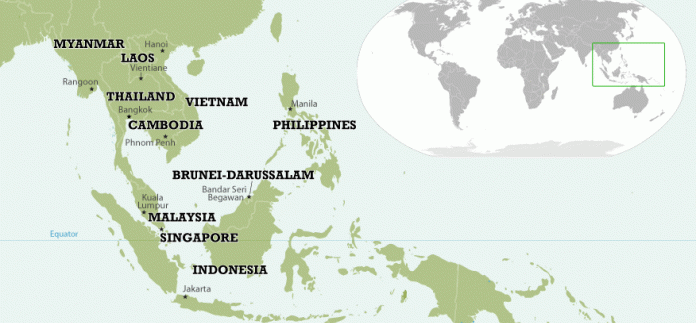
Thailandโ€™s campaign to strengthen fiscal and economic ties with its near neighbours reached a new level in June, with the hosting of a two-day summit for Cambodia, Laos, Myanmar, Vietnam and Thailand (CLMVT). Entitled โ€œCLMVT: Prosper Togetherโ€, the event focused on developing a platform to reinforce sub-regional integration and connectivity in matters of trade, investment and tourism.

While much of the media coverage of the event centred around joint tourism promotions and proposals for visa-free travel between CLMVT countries, the seminarโ€™s main focus was on financial connectivity.

Investing in infrastructure

One of the planks in this platform will be developing financial infrastructure to support the greater flow of capital and information. Veerathai Santiprabhob, governor of the Bank of Thailand (BOT) and a keynote speaker at the conference, emphasised that investing in infrastructure will be crucial to allowing CLMVT countries to work together and meet the demands of the changing financial landscape.

โ€œHaving adequate infrastructure, including a backbone payment system, a digital network and a credit bureau, will provide a sound basis to develop domestic financial systems and facilitate closer financial connectivity,โ€ he said, noting that the development of regional ties will help reduce costs within the sector and across CLMVT economies, boosting cross-border trade and the broader use of e-payment systems.

Financial integration to mobilise funds

Another key message to come out of the conference was that further integration of CLMVT financial markets would support growth in each of the five countries, as well as cross-border expansion.

Speaking during a session on the roles of banking and finance in regional development, Chartsiri Sophonpanich, president of Bangkok Bank, stressed that while growth in the CLMVT region is set to remain strong in the coming years, in line with the 6.5-8.5% range posted in 2015, this could be increased further through tighter financial cooperation, thereby boosting the appeal of CLMVT countries to foreign investors.

Such a move, Sophonpanich said, would mobilise funding and put in place mutually agreed-upon mechanisms to minimise and more evenly distribute risk.

Strengthening the bond market

As the largest economy among the CLMVT bloc, and with the most developed capital markets and banking system, Thailand is well placed to take the lead on the financial connectivity initiative.

Thailandโ€™s bond market is already gaining traction among CLMVT countries, bringing the region closer to financial integration.

In 2013 Laos issued the first in a series of baht-denominated bonds, with the latest coming out last year. At a total face value of BT28bn ($804m), the funds helped finance the Laotian governmentโ€™s infrastructure development programme.

At the corporate level, Laotian utilities firm EDL Generation has also tapped the Thai capital markets, raising BT6.5bn ($187.8m) in late 2014 to fund the acquisition of power stations from its parent company, Electricitรฉ du Laos.

While Laos has been Thailandโ€™s main customer for bond sales, there is strong interest from other countries launching offerings in Thailand.

In 2014 the Cambodian government indicated it could follow the Laotian example by issuing a baht-denominated sovereign bond in 2018. Consultants advising the Cambodian government said at the time that Thailand represented the best opportunity for a sovereign bond launch, as Thai authorities had put in place mechanisms to support such cross-border issues.

More recently, however, Cambodian officials indicated that any baht-denominated bond would require regulatory reforms, similar to what has been suggested by Thailand in its call to lower financial barriers and boost connectivity.

Thailandโ€™s bond market is also attracting interest from further afield. Year-to-date, four foreign lenders โ€“ ANZ Bank of Australia, Central American Bank for Economic Integration, National Bank of Abu Dhabi and Malaysia-based Maybank โ€“ were given regulatory approval to tap Thai markets through a baht bond issue.

The Ministry of Finance has also taken steps to boost the bond marketโ€™s appeal, announcing that, as of January, it would review applications to issue bonds by foreign issuers on a monthly basis, rather than every quarter, citing increased appetite for baht-denominated issues.

BOT opening doors

The BOT is similarly working to boost CLMVT financial connectivity, including by easing regulations to allow firms operating in the GMS to obtain loans from Thai banks for direct sub-regional investment, without setting a lending cap.

According to Santiprabhob, the BOT is encouraging Thai banks to extend their operations into the GMS to promote trade and investment. As of May, Thailand had at least 30 branches and subsidiaries open in the region. Cross-border money transfers have also been facilitated through the establishing of ATM connectivity between Thailand and both Myanmar and Laos, expanding the reach of Thai banks.

15/02/2019No comments,
Thai economy looks to strong first quarter results
A stronger-than-expected performance in the first quarter has prompted analysts to revise their year-end growth forecasts for the Thai economy, though some remained cautious in the face of ongoing challenges both at home and abroad.

Data issued in May by Thailandโ€™s National Economic and Social Development Board (NESDB) put year-on-year (y-o-y) growth for the first quarter of 2016 at 3.2%, the countryโ€™s highest in three years.

The positive results were attributed to high levels of state spending and a strong showing in Thailandโ€™s tourism industry; however, weak export figures have sounded a note of concern.

State spending proves pivotal

Thailandโ€™s economy expanded by 0.9% during the first three months of 2016, up from 0.8% in the previous quarter.

The results prompted the NESDB to revise its year-end forecast to between 3% and 3.5%, up from its previous estimate of between 2.8% and 3.8% in February. The Bank of Thailand (BoT), the countryโ€™s central bank, meanwhile, said it expects the Thai economy to expand by 3.1% in 2016. This comes on 2.5% growth in 2015.

Although the countryโ€™s economy has outperformed initial forecasts, growth remained uneven across sectors.

The government pumped BT654bn ($18.5bn) into the economy through direct expenditure and soft loans in a bid to stimulate growth and aid recovery.

Thailand recorded an 8% y-o-y increase in public consumption in the first quarter, while public investment was up 12.4%. ย The injection of capital helped boost activity and offset more sluggish growth in the private sector, where consumption rose by just 2.3%. Private investment, meanwhile, inched up a more muted 2.1%, according to the NESDB.

Double-digit growth in the construction and tourism sectors contributed significantly to the first-quarter results.

Thailandโ€™s construction sector was up 11.2% y-o-y, supported by strong public investment flows. Increased spending on infrastructure and project development is likely to continue, pointing to a bright outlook for the construction sector and its related industries through 2016 and beyond.

The number of incoming tourists, meanwhile, surged by 15.5% to reach 9m, putting Thailand on track to meet its target of 33m arrivals for the year. The NESDB expects the tourism industry to generate revenues of BT1.68trn ($47.6bn) this year, accounting for 12% of GDP, up from 10% last year.

Hotels and the hospitality industry also benefitted from higher tourist volumes, with the broader services sector recording 15.8% growth.

Setbacks and slowdowns

The first quarter results were more muted for other industries, including manufacturing, agriculture and exports.

Thailandโ€™s manufacturing industry, which accounts for around 30% of GDP, contracted by 0.3% y-o-y, weighed down by declining vehicle output and a slower growth in related industries.

Capacity utilisation in the manufacturing sector remained stagnant at 64% in May, below the historical average of 68%, and could remain at this level due to weak export growth.

Agricultural output, meanwhile, was down for a sixth consecutive quarter, slipping by 1.5% y-o-y on lower demand and adverse weather conditions caused by the El Niรฑo climate pattern, which brought drought to much of Thailand in early 2016.

According to the BoT, exports contracted 1.4% in the first quarter, with the government citing lower commodity and oil prices as well as weak global demand. Among the key segments in decline were industrial goods (7.8%), electronics (5.3%) and agricultural products (2.8%).

A stronger Thai baht, which is up by nearly 2% against the dollar year-to-date, is also expected to curb demand for Thai exports, according to the BoT, which expects exports to decline by 2% over the year โ€“ย a downward revision from the previous forecast of zero growth.

Fluctuating forecasts

Despite broadly positive early indicators for the year, some experts remain cautious. DBS Bank, for example, warned that weak private sector demand, combined with poor showings in manufacturing and agriculture, could weigh on the countryโ€™s full-year growth prospects.

Commenting in a report issued in May, the bank cautioned that ongoing sluggish growth in Thailandโ€™s manufacturing sector could put jobs at risk. The industry currently provides employment for around 16% of Thailandโ€™s workforce.

DBS Bank said full-year growth looked likely to fall short of 3.5%, while also noting that first-quarter growth would have eased to 1.5% if not been for the public sectorโ€™s contributions.

The bankโ€™s prediction followed a move in March by the Asian Development Bank to lower its forecast for Thailandโ€™s GDP growth this year from 3.5% to 3%, citing slower growth in key global economies.

Amid continued economic uncertainty, the BoT chose to hold its key one-day repo rate at 1.5% in May. Senior officials at the BoT cited concerns over financial stability, along with the weakened debt service ability of agricultural households and small businesses.

15/02/2019No comments,
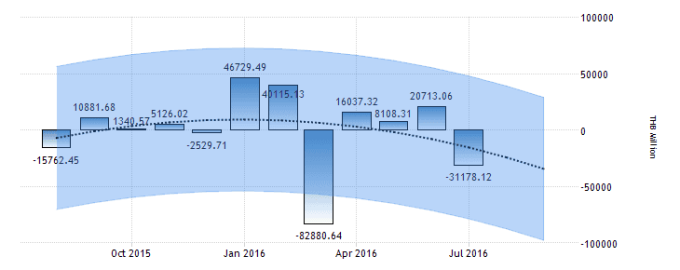
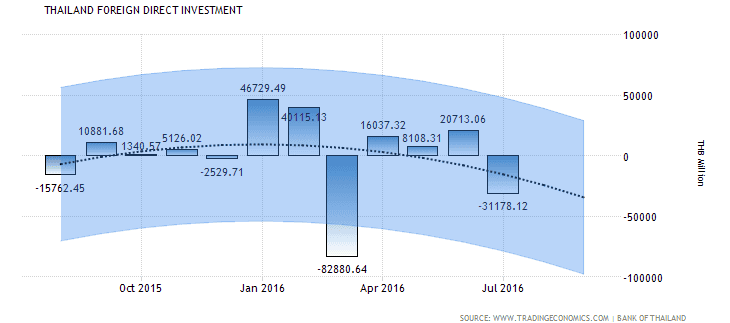
Thailand Foreign Direct Investment
Foreign Direct Investment in Thailand is expected to be -5480.00 THB Million by the end of this quarter, according to Trading Economics global macro models and analysts expectations. Looking forward, we estimate Foreign Direct Investment in Thailand to stand at 20000.00 in 12 months time. In the long-term, the Thailand Foreign Direct Investment is projected to trend around 24000.00 THB Million in 2020, according to our econometric models.

Forecast Actual Q4/16 Q1/17 Q2/17 Q3/17 2020 Unit
Foreign Direct Investment -31178 -5480 -25100 24000 20000 24000 THB Million
Thailand Foreign Direct Investment Forecasts are projected using an autoregressive integrated moving average (ARIMA) model calibrated using our analysts expectations. We model the past behaviour of Thailand Foreign Direct Investment using vast amounts of historical data and we adjust the coefficients of the econometric model by taking into account our analysts assessments and future expectations. The forecast for โ€“ Thailand Foreign Direct Investment โ€“ was last predicted on Sunday, October 23, 2016.
Thailand Trade Last Q4/16 Q1/17 Q2/17 Q3/17 2020
Balance of Trade 2130 351 2614 2442 1575 135
Exports 18830 16658 17729 18480 16965 19045
Imports 16700 16308 15115 16038 15390 18910
Current Account 3810 5200 4700 4000 1400 5000
Current Account to GDP 3.8 2.66 2.89 3.12 3.35 2.37
External Debt 143135 149251 150779 152133 135538 139000
Terms of Trade 114 113 113 113 113 113
Tourist Arrivals 2874420 2690763 2702194 2700646 2700806 3010000
Gold Reserves 152 152 152 152 152 152
Terrorism Index 7.28 7.35 7.25 7.25 7.25 6.8
Remittances 9545 8452 8299 8230 8193 8149
Crude Oil Production 245 230 220 255 220 250
Foreign Direct Investment -31178 -5480 -25100 24000 20000 24000
15/02/2019No comments,
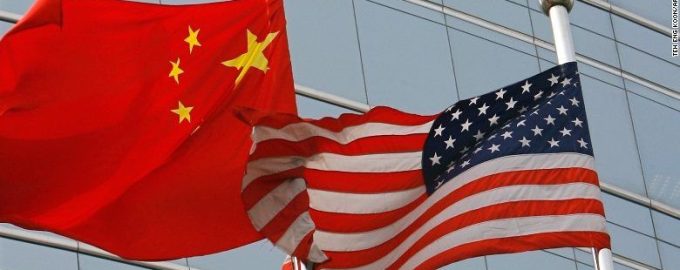
The Chinese Dream is coming true for millions

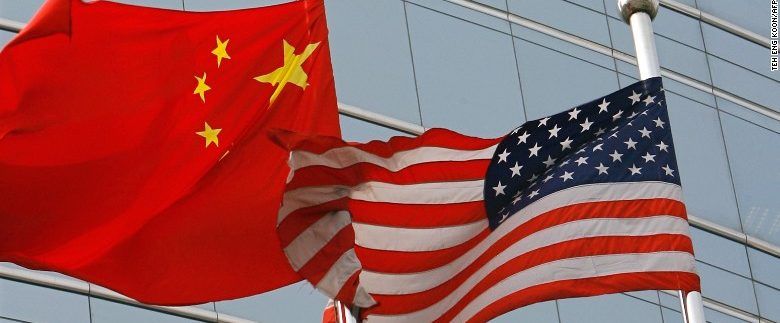
Chinaโ€™s middle class is now the biggest in the world, and growing much faster than Americaโ€™s, according to research by Credit Suisse.

There are 109 million Chinese with wealth of between $50,000 and $500,000. Since 2000, twice as many Chinese as Americans have joined the middle class.

Credit Suisse measured wealth rather than income to avoid temporary changes caused by unemployment, for example.

Chinese are getting richer at an astonishing rate. Wealth per adult has quadrupled to about $22,500 since 2000. The country now accounts for a fifth of the worldโ€™s population, while holding about 10% of global wealth.

โ€œThe wealth of the countryโ€™s households could well continue to leapfrog the growth rates of developed economies,โ€ Credit Suisse said.

China should also see the number of millionaires soar 74% to 2.3 million by 2020, according to the report.

A report by UBS and PricewaterhouseCoopers found that a new billionaire was created almost every week in China in the first quarter of the year.

Make a right investment

15/02/2019No comments,
BOI increases investment target by 20% to 450 billion baht

The Board of Investment of Thailand (BOI) has expanded its 2016 investment value target to 550,000 million baht ($ 16 Bln), an increase of about 20% from the previous target of 450,000 million baht

Improved political and economic situation enhance investment climate and investorsโ€™ confidence andย New opportunities explored in overseas markets while actual investment activities in Thailand to be accelerated.

BOI manpower to be expanded to support more aggressive investment promotion Driven by political and economic recovery, the Board of Investment of Thailand (BOI) has expanded its 2016 investment value target to 550,000 million baht ($ 16 Bln), an increase of about 20% from the previous target of 450,000 million baht.

The new target was announced at the annual meeting, chaired by Deputy Prime Minister Somkid Jatusripitak, with the heads of the BOIโ€™s 14 overseas offices today. Mr Somkid updated the meeting in Bangkok about the positive signal in political and economic recovery and global investment trend that moves toward Asia.

Considering such trend, he recommended BOI to increase manpower to support the expected increase in investment inflow and to grow new and existing markets across Asia, including Japan, Korea, China, India as well as Singapore.

โ€œOther advantages, such as the benefits of using Thailand as the hub to grow business in China, ASEAN and India can be highlighted to draw more investmentโ€

BOI has adjusted its application target from 450,000 million baht to 550,000 million baht. The 10 target industries will remain in focus. We hope to increase the proportion of investment in these target industries to more than 50% of the total investment application.

โ€œConsidering the very positive trend in investment applications, coupled with strong investorsโ€™ confidence towards economic and political development in Thailand, we are certain to achieve the new investment goal by the end of 2016.โ€

In the first seven months of 2016, the number of investment incentive applications by project increased by 77% while application value soared by 218%.

The BOI received 853 applications worth 320,720 million baht, up from 483 projects with a value of 100,740 million baht in the same period of 2015.

The value of project applications in the 10 target industries accounted for 43% of the total applications or 138,871 million baht, reflecting the success of investment promotion policy and execution. An investor confidence survey done by the BOI in May 2016 also showed a positive trend.

The survey, released last week, indicated that 32.8% of companies currently investing in the country have plans to expand their investment. The majority of respondents cited good infrastructure, sufficient supplies of parts and suppliers, efficient logistics and strong investment promotion incentives as key factors behind their decisions.

Meanwhile, investorsโ€™ concerns over political and economic instability have significantly decreased from the same period last year, showing overall improved confidence in Thailandโ€™s political and economic development.

Investorsโ€™ concern over the government sectorโ€™s transparency has significantly dropped from 30.15% in 2015 down to only 19.38%. In addition, the increase in GDP growth from 3.2% in the first quarter this year to 3.5% in the second quarter contributed to improved confidence among investors and the business sector in the Thai economy and its outlook.

โ€œThanks to these positive factors, the overall investment outlook is promising,โ€ said Mrs Hirunya.

To maintain and enhance the positive investment momentum and confidence, the BOI will continue its plan to promote Thai investment opportunities in major markets through international road shows. In the remaining four months, a total of more than 40 road shows are planned in major markets, such as Japan, South Korea, China and northern Europe. The BOI will also work closely with its partners worldwide, including leading organisations in the trade, investment and banking sectors.

Honorary investment advisers will provide information about investment opportunities and government support in Thailand.

โ€œWith a concerted effort from the BOIโ€™s 14 overseas offices worldwide, local offices and concerned government organisations, we hope to attract more investment from foreign investors, especially in the 10 target industries that are crucial to supporting the transformation of Thailand to a knowledge-based economy. Coupled with the positive development trend and political and economic stability, the countryโ€™s strength as the gateway to ASEAN and South Asia, as well as the upcoming laws that enhance investment climate, including the new BOI law, Eastern Economic Corridor (EEC) law and the competitiveness fund law, Thailand is positioned well as the desirable investment destination,โ€ said Mrs Hirunya.

Make a right investment

15/02/2019No comments,
Thai investors are grabbing more deals in Vietnam

The total FDI into ASEAN countries in 2014 hit $136.2 billion, and Vietnam was the best performer among emerging territories in receiving inbound investment, according to the United Nations Conference on Trade and Development.

Companies in Thailand and Japan are both eager to grow outside their home markets, which have witnessed low growth and have mature markets, in contrast to Vietnamโ€™s soaring rate.

Vietnamโ€™s politicians also revised the nationโ€™s laws covering M&As, to make the process quicker and more transparent. A new law enacted in July has cut the time to acquire an investment license to just 15 days, a reduction of about two-thirds of the earlier duration.

A month earlier, the government said that foreigners can now buy majority stakes in certain kinds of listed companies.

Vietnam has also specified 18 industries includingย consumer, property, transport, construction and manufacturing, where foreign investment is allowed.

Taken together, these measures have laid out a clearer path for companies interested in M&A.

โ€œThai companies have acted more swiftly than their Japanese counterparts in striking M&A deals.โ€

Yoshida said that the reason was slower decision making process in Japan.Thai companies Central Group and TCC Holding expanded their presence in Vietnamโ€™s retail market with the acquisitions of Big C Vietnam, and the Vietnam operations of fashion e-commerce platform Zalora and Metro Cash&Carry.

Another big-ticket deal that involves a Thai corporate buyer is the $1.1 billion transaction to buy majority stakeย inย Masan Groupโ€˜s subsidiaries.

Meanwhile, Japanese investors have been active in various sectors, including ANA Holdingsโ€˜ strategic investment in Vietnam Airlines, Taishoโ€™s acquisition of over 24 per cent in DHG Pharma, JX Nippon Oil & Energyโ€™s 8 per cent shareholding in Petrolimexย โ€” the countryโ€™s largest distributor of petroleum products โ€” and AEONโ€˜s purchase of two local retailers.

Choose your investment

15/02/2019No comments,
ASEANโ€™s Sharing Economy: Understanding Opportunities and Navigating Regulations

As internet penetration rates continue to rise in Southeast Asia, ASEAN grows more interconnected by the day.

Home to over 663 million inhabitants, the region is projected by many to beย among the worldโ€™s most promising markets for a variety of internet based services.

Chief among these are servicesย involved in what has been coined the โ€œsharing economyโ€ โ€“ a loose collection of peer-to-peer services known to substantially lower costs for key necessities such as transport and accommodation.

In a 2014 study conducted by Nielsen, Indonesia and the Philippines ranked as two of the top five populations worldwide primed to participate in the sharing economy. While Indonesia ranked second in the study, with 87 percent of respondents reporting a willingness to utilize products within a sharing economy, the Philippines only trailed by two percentage points, earning fourth place Vietnam

Thailand: New KYC Guidelines Issued

Thailandโ€™s central Bank of Thailand (BOT) has introduced new regulations to ease the Know Your Customer (KYC) process using the electronic process (e-KYC) to open accounts on deposit acceptance of funds accepted from the public. Financial institutions globally are increasingly being required to comply with KYC guidelines under the anti-money laundering law (AML). As per the BOT Notification No. SorNOrSor. 7/2559 the following guidelines have been issued.

  • E-KYC procedures must have the same standards as KYC procedures and available only for individual customers using electronic means such as computers, mobile phones, other electronic devices etc. Financial institutions however, must get prior approval from the BOT.
  • Electronic signatures are acceptable.
  • Verification of customers must be done using ID cards or a smart card reader
  • Financial institutions must retain all information including KYC documents or their copies as per the AML law.

The regulation went into effect in August.

Vietnam

Asย Vietnam increasingly becomes a hub for foreign businesses, the government is streamlining the mergers and acquisitions (M&A) process to encourage investment in new sectors of the economy. While establishing aย business in Vietnam may prove too cumbersome for some hopeful entrants, the M&A route provides a unique solution to many of these obstacles. With this path, investors will enjoy preexisting access to consumers, locations, and distribution channels.ย This local knowledge can prove critical to successful operations within Vietnamโ€™s vibrant butย rapidly changing investment environment .

To successfully carry out M&As within Vietnam, it is important to recognize the legal foundation of current policies, and to understand the procedures and limitations associated with acquisitions in Vietnam..

Make a right investment

15/02/2019No comments,
Gallery Sample

Lorem ipsum dolor sit amet, consectetuer adipiscing elit, sed diam nonummy nibh euismod tincidunt ut laoreet dolore magna aliquam erat volutpat. Ut wisi enim ad minim veniam, quis nostrud exerci tation ullamcorper suscipit lobortis nisl ut aliquip ex ea commodo consequat….

06/12/2014No comments
Article Clone

Lorem ipsum dolor sit amet, consectetuer adipiscing elit, sed diam nonummy nibh euismod tincidunt ut laoreet dolore magna aliquam erat volutpat. Ut wisi enim ad minim veniam, quis nostrud exerci tation ullamcorper suscipit lobortis nisl ut aliquip ex ea commodo consequat. Duis autem vel eum iriure dolor in hendrerit in vulputate velit esse molestie consequat, vel illum dolore eu feugiat nulla facilisis at vero eros et accumsan et iusto odio dignissim qui blandit praesent luptatum zzril delenit augue duis dolore te feugait nulla facilisi. Nam liber tempor cum soluta nobis eleifend option congue nihil imperdiet doming id quod mazim placerat facer possim assum. Typi non habent claritatem insitam; est usus legentis in iis qui facit eorum claritatem. Investigationes demonstraverunt lectores legere me lius quod ii legunt saepius. Claritas est etiam processus dynamicus, qui sequitur mutationem consuetudium lectorum. Mirum est notare quam littera gothica, quam nunc putamus parum claram, anteposuerit litterarum formas humanitatis per seacula quarta decima et quinta decima. Eodem modo typi, qui nunc nobis videntur parum clari, fiant sollemnes in futurum.

24/11/2014No comments
Article Latest

Lorem ipsum dolor sit amet, consectetuer adipiscing elit, sed diam nonummy nibh euismod tincidunt ut laoreet dolore magna aliquam erat volutpat. Ut wisi enim ad minim veniam, quis nostrud exerci tation ullamcorper suscipit lobortis nisl ut aliquip ex ea commodo consequat. Duis autem vel eum iriure dolor in hendrerit in vulputate velit esse molestie consequat, vel illum dolore eu feugiat nulla facilisis at vero eros et accumsan et iusto odio dignissim qui blandit praesent luptatum zzril delenit augue duis dolore te feugait nulla facilisi. Nam liber tempor cum soluta nobis eleifend option congue nihil imperdiet doming id quod mazim placerat facer possim assum. Typi non habent claritatem insitam; est usus legentis in iis qui facit eorum claritatem. Investigationes demonstraverunt lectores legere me lius quod ii legunt saepius. Claritas est etiam processus dynamicus, qui sequitur mutationem consuetudium lectorum. Mirum est notare quam littera gothica, quam nunc putamus parum claram, anteposuerit litterarum formas humanitatis per seacula quarta decima et quinta decima. Eodem modo typi, qui nunc nobis videntur parum clari, fiant sollemnes in futurum.

24/11/2014No comments
Article New

Lorem ipsum dolor sit amet, consectetuer adipiscing elit, sed diam nonummy nibh euismod tincidunt ut laoreet dolore magna aliquam erat volutpat. Ut wisi enim ad minim veniam, quis nostrud exerci tation ullamcorper suscipit lobortis nisl ut aliquip ex ea commodo consequat. Duis autem vel eum iriure dolor in hendrerit in vulputate velit esse molestie consequat, vel illum dolore eu feugiat nulla facilisis at vero eros et accumsan et iusto odio dignissim qui blandit praesent luptatum zzril delenit augue duis dolore te feugait nulla facilisi. Nam liber tempor cum soluta nobis eleifend option congue nihil imperdiet doming id quod mazim placerat facer possim assum. Typi non habent claritatem insitam; est usus legentis in iis qui facit eorum claritatem. Investigationes demonstraverunt lectores legere me lius quod ii legunt saepius. Claritas est etiam processus dynamicus, qui sequitur mutationem consuetudium lectorum. Mirum est notare quam littera gothica, quam nunc putamus parum claram, anteposuerit litterarum formas humanitatis per seacula quarta decima et quinta decima. Eodem modo typi, qui nunc nobis videntur parum clari, fiant sollemnes in futurum.

24/11/2014No comments
Article Title

Lorem ipsum dolor sit amet, consectetuer adipiscing elit, sed diam nonummy nibh euismod tincidunt ut laoreet dolore magna aliquam erat volutpat. Ut wisi enim ad minim veniam, quis nostrud exerci tation ullamcorper suscipit lobortis nisl ut aliquip ex ea commodo consequat. Duis autem vel eum iriure dolor in hendrerit in vulputate velit esse molestie consequat, vel illum dolore eu feugiat nulla facilisis at vero eros et accumsan et iusto odio dignissim qui blandit praesent luptatum zzril delenit augue duis dolore te feugait nulla facilisi. Nam liber tempor cum soluta nobis eleifend option congue nihil imperdiet doming id quod mazim placerat facer possim assum. Typi non habent claritatem insitam; est usus legentis in iis qui facit eorum claritatem. Investigationes demonstraverunt lectores legere me lius quod ii legunt saepius. Claritas est etiam processus dynamicus, qui sequitur mutationem consuetudium lectorum. Mirum est notare quam littera gothica, quam nunc putamus parum claram, anteposuerit litterarum formas humanitatis per seacula quarta decima et quinta decima. Eodem modo typi, qui nunc nobis videntur parum clari, fiant sollemnes in futurum.

24/11/2014No comments