
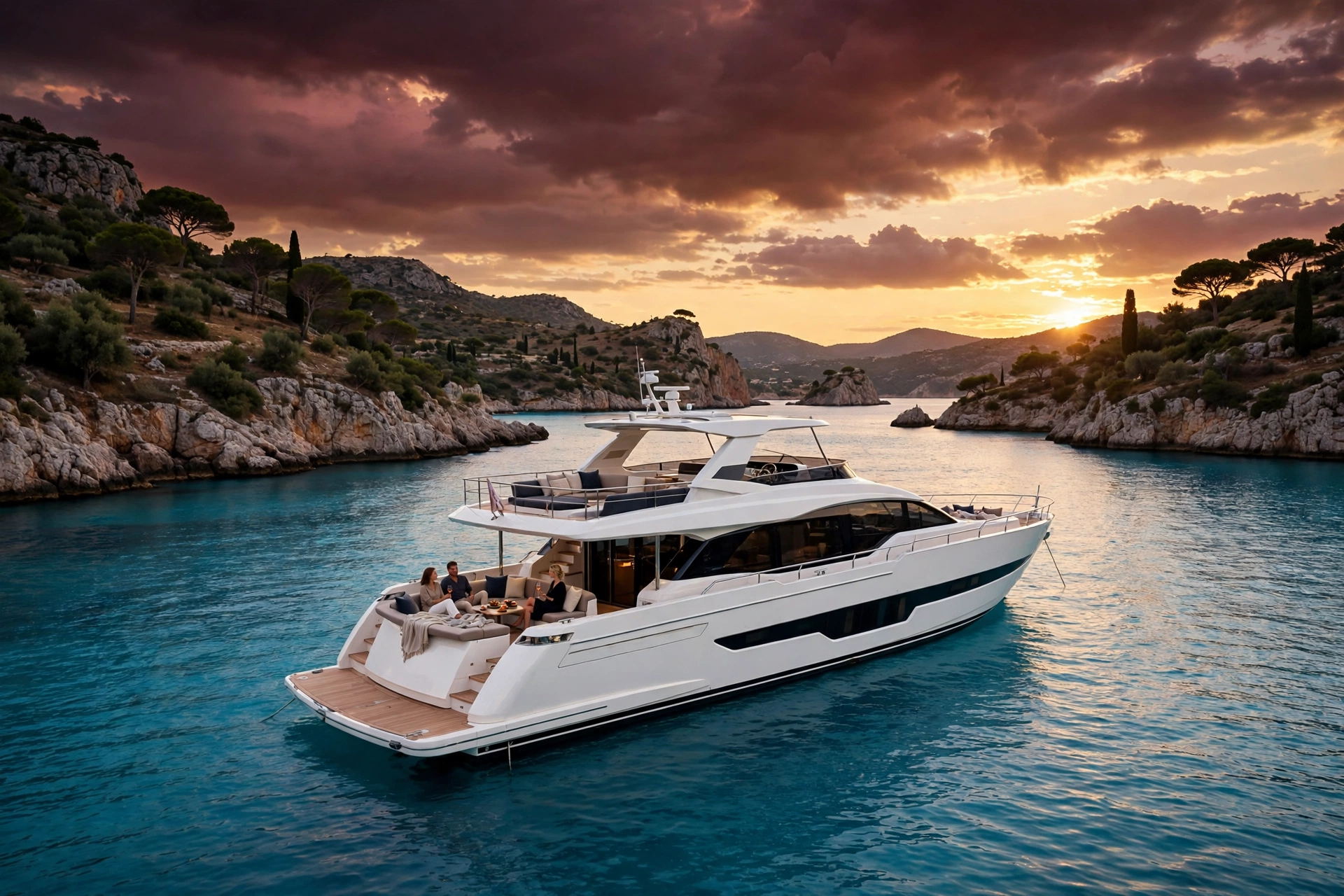
The cost to rent a yacht for a week in 2026 runs from about $2,000 for a small bareboat sailing yacht to more than $300,000 for a crewed superyacht. Most people booking a week fall somewhere in the middle: a skippered catamaran for a family of eight costs roughly $7,000–$14,000 a week, while a crewed motor yacht of 60–80 feet costs about $25,000–$60,000 a week.
The weekly rate is the standard unit in yacht rental. Most markets run Saturday-to-Saturday weeks, and the price you see quoted is almost never the price you actually pay: on a crewed charter, the extras on top of the headline rate typically add 45–70% to the bill. This guide gives real 2026 weekly prices by yacht type and size, explains what sits on top of the rate, and shows how to work out your true all-in cost before you book.
What a Weekly Yacht Rental Actually Covers
A week on a yacht means seven days aboard, usually boarding on a Saturday afternoon and leaving the following Saturday morning. The price depends on four things more than anything else: the type of yacht, its size, where you sail, and when you go.
There are four main ways to rent a yacht for a week, and the price gap between them is large:
| Rental type | What you get | Who sails it | Typical weekly cost |
|---|---|---|---|
| Bareboat | Just the yacht | You (licence required) | From ~$2,000 |
| Skippered | Yacht + skipper | A professional skipper | From ~$7,000 |
| Crewed | Yacht + full crew + chef | Captain, chef, stewardess | From ~€12,000 |
| All-inclusive crewed | Yacht + crew + food + fuel | Full crew, everything included | From ~$25,000 |
A bareboat charter is the cheapest way to spend a week on a yacht, but you need a recognised sailing licence (an ICC in most of the Mediterranean, plus a VHF certificate) and you do all the cooking, cleaning and sailing yourself. A skippered charter adds a professional skipper for roughly €150–€300 a day and is the best value for most first-timers. A crewed charter is the full service: captain, chef and stewardess, with meals arranged for you. In the Caribbean, many smaller crewed yachts are quoted all-inclusive, so food, standard drinks and fuel are already in the rate and there is no APA to manage.
Cost to Rent a Yacht for a Week by Yacht Type
Weekly base rates in 2026 break down roughly like this, before the extras:
| Yacht type | Size | Weekly base rate | Source |
|---|---|---|---|
| Bareboat monohull sailboat | 35–45 ft | $2,000–$6,000 | Master Ocean, 2026 |
| Bareboat catamaran | 40–45 ft | $4,500–$9,000 | Master Ocean, 2026 |
| Bareboat sailboat | 10–12 m | €700–€1,500 low / €1,400–€3,500 high season | CharterIO, Mar 2026 |
| Bareboat catamaran | 12–14 m | €1,800–€3,500 low / €3,500–€7,000 high season | CharterIO, Mar 2026 |
| Skippered catamaran | 45–50 ft | $7,000–$14,000 | Master Ocean, 2026 |
| Skippered catamaran | 12–14 m | €3,000–€6,500 low / €6,000–€12,000 high season | CharterIO, Mar 2026 |
| Traditional gulet | 8–12 guests | €2,500–€5,000 low / €5,000–€12,000 high season | CharterIO, Mar 2026 |
| Crewed catamaran | 55–70 ft | €27,000–€48,000 (high season) | DMA Yachting, Oct 2026 |
| Crewed motor yacht, entry tier | 60–80 ft | $25,000–$60,000 | Master Ocean, 2026 |
| Crewed motor yacht | 80–100 ft | €52,500–€70,000 (high season) | DMA Yachting, Oct 2026 |
| Crewed motor yacht, mid tier | 90–120 ft | $70,000–$180,000 | Master Ocean, 2026 |
| Superyacht | 130 ft and up | $200,000–$300,000+ | Master Ocean, 2026 |
| Superyacht | 130–165 ft | €160,000–€210,000 (high season) | DMA Yachting, Oct 2026 |
Split between guests, a week on the water is often cheaper than it looks. A skippered catamaran at $7,000–$14,000 a week split among eight guests works out at roughly $500–$800 per person for the week, base fee only, before the extras. That is less per head than a decent hotel room for the same seven nights, with the yacht, the route and the crew included.
Weekly Prices by Yacht Size
Length drives the weekly rate more than anything else: a bigger yacht means more guests, more crew and more fuel. Classic Charters’ October 2026 data, from 151 crewed yachts with a published weekly rate, puts the typical starting rate at €26,500 a week for yachts under 30 metres, €51,000 for 30–40 metres, €100,000 for 40–60 metres, and €325,000 for yachts of 60 metres and over. Half of the yachts they feature start below €60,500 a week.
| Yacht size | Typical starting weekly rate | Range |
|---|---|---|
| Under 30 m | €26,500 | €12,250–€53,253 |
| 30–40 m | €51,000 | €15,750–€160,202 |
| 40–60 m | €100,000 | €45,500–€240,000 |
| 60 m and over | €325,000 | €105,000–€700,000 |
By style, sailing yachts start at a typical €38,500 a week and motor yachts at €74,500. Yacht.com’s analysis of more than 2,500 real charter yachts gives a similar picture in dollars: a mini motor yacht averages about $22,889 a week, a small motor yacht about $29,422, a small sailing yacht about $33,090, and a mid-size yacht of 60–80 feet about $39,000–$48,000 a week. The vast majority of week-long crewed charters land between $40,000 and $150,000, covering the 24–40 metre bracket where most guests actually book.
Weekly Prices by Destination
The same yacht costs a different amount depending on where it sails. The Mediterranean is the most expensive market in the world; the Caribbean and the USA offer better value overall.
| Destination | Medium yachts (under 60 ft) | Large yachts (60–100 ft) | Superyachts (100 ft+) |
|---|---|---|---|
| Mediterranean | $12,000–$30,000/week | $35,000–$100,000/week | $100,000–$500,000+/week |
| Caribbean | $16,000–$60,000/week | $40,000–$100,000/week | $80,000–$400,000+/week |
| USA / Florida | $15,000–$60,000/week | $50,000–$150,000/week | $100,000–$450,000+/week |
Within the Mediterranean there are real differences too. The French Riviera is the most expensive, at roughly $18,000–$25,000 a week for a medium yacht and $120,000+ for a superyacht. Greece, Croatia and Turkey are the best-value Mediterranean markets for a bareboat or skippered sailing yacht: a 4-cabin sailing yacht runs about €3,755 a week in Greece, €3,800 in Croatia and €3,200 in Turkey, against €4,200 on the French Riviera.
Season matters as much as place. High season in the Mediterranean is July and August, when prices can double compared with mid-season. May–June and September are the best value: fewer boats on the water, pleasant weather, and lower prices. The Caribbean season is the opposite — November to April — and many yachts cross the Atlantic between the two.

What Sits on Top of the Weekly Rate
The headline weekly rate is only the start. On a crewed charter in the Mediterranean, the base rate buys the yacht and the crew. Nearly everything else is extra, and the extras typically add 35–50% on top of the base fee before VAT. Master Ocean’s 2026 guidance is to budget 1.45 to 1.7 times the quoted base fee for the total cost of a charter. For a clear breakdown of that multiplier and what it covers, see Master Ocean’s charter budget guide.
APA (Advance Provisioning Allowance). The APA is a cash advance you pay before the charter to cover running costs — fuel, food and drink, port and marina fees, and water toys. The captain spends it on your behalf and returns what is left. It is usually 20–40% of the charter fee: around 20–30% for a catamaran and 30–40% for a motor yacht, which burns more fuel. In the Caribbean, many charters are all-inclusive instead, so there is no APA at all.
VAT and local taxes. VAT is added to the charter fee, not the APA, and the rate depends on the country: 21% in Spain, 13–24% in Greece depending on the yacht’s licence and the length of the trip, and similar rates in France, Italy and Croatia. Always confirm the VAT rate on your quote — it is a large number on a large charter.
Crew gratuity. The Mediterranean norm is a tip of 10–20% of the charter fee for good service, usually in cash to the captain at the end of the trip. Some operators quote 5–15%; either way, it is discretionary, not contractual.
Security deposit. On a bareboat or skippered charter you also pay a refundable security deposit, typically €1,900–€2,750 for a sailing yacht, held against damage and returned after the trip.
A worked example makes the real cost clear. A crewed catamaran at €30,000 a week in the Mediterranean, plus a 30% APA (€9,000), plus 21% Spanish VAT on the base fee (€6,300), plus a 10% crew tip (€3,000), comes to €48,300 all-in — 61% more than the headline rate. Always ask for the full cost breakdown in writing before you pay anything.
New vs Older Yacht: What a Week Costs
A newer yacht costs more per week than an older yacht of the same size, and the gap is worth knowing about. A yacht built in the last few years commands a premium for its condition, its newer water toys and its modern interior. An older yacht — ten to fifteen years old, well maintained — can cost 20–40% less per week for the same length and cabin count.
The trade-off is real but small for most renters. The older yacht may have a smaller swim platform, an older tender or a simpler sound system, but the route, the sea and the crew are the same. If your budget is fixed, an older yacht in the shoulder season is the single best way to get more boat for your money: a 50-foot catamaran from 2015 in June can cost less per week than a 45-foot catamaran from 2024 in August. Always check the refit date, not just the build year — a yacht refitted in 2023 can feel newer than one built in 2020 and never touched.
How to Book a Yacht for a Week
Renting a yacht for a week follows a clear seven-step process. It looks formal, but it is designed to protect you as much as the owner.
- Define your brief. Group size, dates, destination and your all-in budget — not just the base rate, but the APA, VAT and tip as well. Tell the broker your non-negotiables: a chef, water toys, a specific island, a cabin layout.
- Contact a reputable charter broker. Ideally a MYBA member. The broker’s commission is paid by the owner, not by you, and a good broker has actually been aboard the yachts they recommend. Be wary of booking a first crewed charter through a generic listing platform where nobody has set foot on the boat.
- Compare two to five proposals. The broker sends a shortlist with specs, photos, crew profiles and guest reviews. Take the crew profiles seriously: on a crewed charter, the crew makes or breaks the trip more than the yacht itself does.
- Sign the charter agreement and pay the deposit. Most crewed charters use the MYBA Charter Agreement, the industry-standard contract. The deposit is usually 50% of the charter fee, paid by bank transfer to an escrow or holding account, not directly to the owner. Check the dates, embarkation port, payment schedule and cancellation terms before you sign.
- Fill in the preference sheet. Four to six weeks before departure, your broker sends a preference sheet for meals, drinks, allergies, activities and itinerary wishes. Be specific: this is what turns a booked yacht into your yacht.
- Pay the balance and the APA. The remaining 50% of the charter fee, plus the full APA and the VAT, is usually due 30 days before embarkation (four to six weeks on some contracts). Your broker will remind you in advance.
- Board, enjoy, and tip the crew. Most crewed charters in Greece run noon-to-noon; some run 5 pm boarding to 9 am disembarkation. The captain gives a safety briefing and a tour, then the itinerary you agreed with the captain takes over. At the end, the captain settles the APA account with receipts and refunds any unused balance.
Book early for peak dates. The best yachts in the French Riviera and the Greek islands are often booked a year ahead for July and August, and a broker can place a short courtesy hold on a yacht, usually for a few days, while you decide.
If you are still deciding which yacht fits your week, the best next step is to look at what is actually available. Browse the current yacht charters on Zonezi and compare real yachts side by side, with prices, sizes and locations. And if you want the full price picture first, our guide to how much to rent a yacht breaks down weekly prices by yacht size in detail.
Frequently Asked Questions
How much does it cost to rent a yacht for a week?
It depends on size, type, destination and season. A bareboat sailing yacht starts at about $2,000 a week; a skippered catamaran costs about $7,000–$14,000 a week; a crewed catamaran of 55–70 ft costs about €27,000–€48,000 a week in high season; a crewed motor yacht of 80–100 ft costs about €52,500–€70,000 a week; and a superyacht of 130 ft and over costs $200,000–$300,000+ a week. Add 35–50% on top for APA, VAT and crew tip.
What is the cheapest way to rent a yacht for a week?
A bareboat sailing yacht in the low season in Greece, Croatia or Turkey — from about €700–€1,500 a week for a 10–12 metre boat, plus a refundable security deposit. You need a sailing licence and you do everything yourself. A skippered catamaran in the shoulder season, split among eight guests, is the cheapest crewed option at roughly $500–$800 per person for the week, base fee only.
What is included in the weekly rental price?
On a crewed charter, the base rate covers the yacht, the crew’s wages, insurance and everyday consumables aboard. Fuel, food and drink, port fees and the crew tip are extra, paid through the APA and a tip. On a bareboat charter, the rate covers only the yacht — you pay for fuel, food, mooring and the security deposit yourself. In the Caribbean, many crewed charters are all-inclusive, so food, drinks and fuel are already in the rate.
What is the APA on a yacht charter?
The Advance Provisioning Allowance is a cash advance, usually 20–40% of the charter fee, paid before the trip to cover fuel, food, drinks and port fees. The captain spends it on your behalf, accounts for it with receipts, and refunds any unused balance at the end. Many Caribbean charters are all-inclusive instead, so there is no APA.
When is the cheapest week to rent a yacht?
May–June and September in the Mediterranean give the best value: lower prices, fewer boats and good weather. July and August are the most expensive, with prices that can double. In the Caribbean the season is November to April, so the cheapest weeks there are the shoulder months at either end. Book a year ahead for peak July and August dates in the French Riviera and the Greek islands.
How far in advance should I book a yacht for a week?
For a peak-season crewed yacht, six to twelve months ahead is normal — the best yachts book out a year in advance. For a shoulder-season or bareboat charter, a few weeks can be enough, and last-minute deals do appear, but the choice is much smaller. A broker can hold a yacht for a few days with a courtesy option while you decide, at no cost.
The Bottom Line
The cost to rent a yacht for a week in 2026 starts at about $2,000 for a bareboat sailing yacht and rises past $300,000 for a crewed superyacht, with most week-long crewed charters landing between $40,000 and $150,000. The headline rate is only part of the bill: budget another 45–70% for the APA, VAT and crew tip, and always get the full breakdown in writing before you pay the 50% deposit. Pick the rental type that fits your experience — bareboat if you can sail, skippered if you want a hand, crewed if you want the full service — book the shoulder season if your dates are flexible, and use a MYBA broker so the contract, the deposit and the yacht itself are all properly covered. If you are ready to look, start with the yacht charters on Zonezi and see what is available right now.