Thailand Foreign Direct Investment

Thailand Foreign Direct Investment
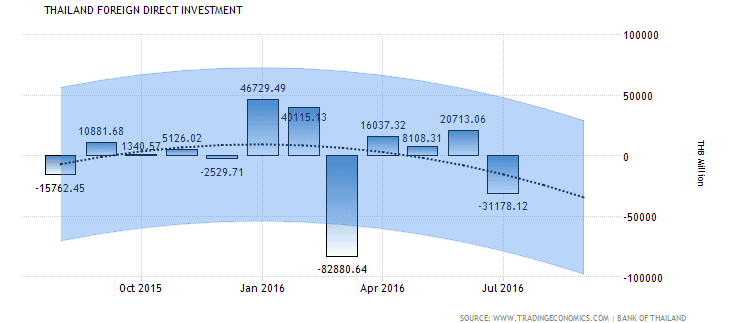
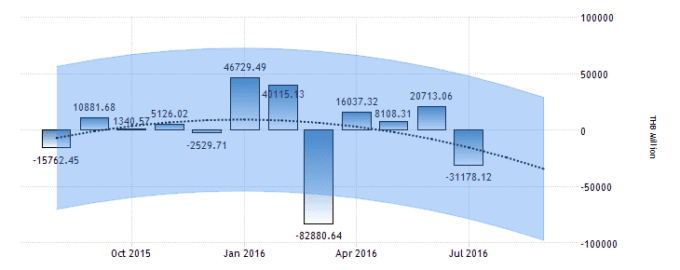
Foreign Direct Investment in Thailand is expected to be -5480.00 THB Million by the end of this quarter, according to Trading Economics global macro models and analysts expectations. Looking forward, we estimate Foreign Direct Investment in Thailand to stand at 20000.00 in 12 months time. In the long-term, the Thailand Foreign Direct Investment is projected to trend around 24000.00 THB Million in 2020, according to our econometric models.

Forecast Actual Q4/16 Q1/17 Q2/17 Q3/17 2020 Unit
Foreign Direct Investment -31178 -5480 -25100 24000 20000 24000 THB Million
Thailand Foreign Direct Investment Forecasts are projected using an autoregressive integrated moving average (ARIMA) model calibrated using our analysts expectations. We model the past behaviour of Thailand Foreign Direct Investment using vast amounts of historical data and we adjust the coefficients of the econometric model by taking into account our analysts assessments and future expectations. The forecast for – Thailand Foreign Direct Investment – was last predicted on Sunday, October 23, 2016.
Thailand Trade Last Q4/16 Q1/17 Q2/17 Q3/17 2020
Balance of Trade 2130 351 2614 2442 1575 135
Exports 18830 16658 17729 18480 16965 19045
Imports 16700 16308 15115 16038 15390 18910
Current Account 3810 5200 4700 4000 1400 5000
Current Account to GDP 3.8 2.66 2.89 3.12 3.35 2.37
External Debt 143135 149251 150779 152133 135538 139000
Terms of Trade 114 113 113 113 113 113
Tourist Arrivals 2874420 2690763 2702194 2700646 2700806 3010000
Gold Reserves 152 152 152 152 152 152
Terrorism Index 7.28 7.35 7.25 7.25 7.25 6.8
Remittances 9545 8452 8299 8230 8193 8149
Crude Oil Production 245 230 220 255 220 250
Foreign Direct Investment -31178 -5480 -25100 24000 20000 24000
15/02/2019No comments,
The Chinese Dream is coming true for millions

China’s middle class is now the biggest in the world, and growing much faster than America’s, according to research by Credit Suisse.

There are 109 million Chinese with wealth of between $50,000 and $500,000. Since 2000, twice as many Chinese as Americans have joined the middle class.

Credit Suisse measured wealth rather than income to avoid temporary changes caused by unemployment, for example.

Chinese are getting richer at an astonishing rate. Wealth per adult has quadrupled to about $22,500 since 2000. The country now accounts for a fifth of the world’s population, while holding about 10% of global wealth.

“The wealth of the country’s households could well continue to leapfrog the growth rates of developed economies,” Credit Suisse said.

China should also see the number of millionaires soar 74% to 2.3 million by 2020, according to the report.

A report by UBS and PricewaterhouseCoopers found that a new billionaire was created almost every week in China in the first quarter of the year.

Make a right investment

15/02/2019No comments,
BOI increases investment target by 20% to 450 billion baht

The Board of Investment of Thailand (BOI) has expanded its 2016 investment value target to 550,000 million baht ($ 16 Bln), an increase of about 20% from the previous target of 450,000 million baht

Improved political and economic situation enhance investment climate and investors’ confidence and New opportunities explored in overseas markets while actual investment activities in Thailand to be accelerated.

BOI manpower to be expanded to support more aggressive investment promotion Driven by political and economic recovery, the Board of Investment of Thailand (BOI) has expanded its 2016 investment value target to 550,000 million baht ($ 16 Bln), an increase of about 20% from the previous target of 450,000 million baht.

The new target was announced at the annual meeting, chaired by Deputy Prime Minister Somkid Jatusripitak, with the heads of the BOI’s 14 overseas offices today. Mr Somkid updated the meeting in Bangkok about the positive signal in political and economic recovery and global investment trend that moves toward Asia.

Considering such trend, he recommended BOI to increase manpower to support the expected increase in investment inflow and to grow new and existing markets across Asia, including Japan, Korea, China, India as well as Singapore.

“Other advantages, such as the benefits of using Thailand as the hub to grow business in China, ASEAN and India can be highlighted to draw more investment”

BOI has adjusted its application target from 450,000 million baht to 550,000 million baht. The 10 target industries will remain in focus. We hope to increase the proportion of investment in these target industries to more than 50% of the total investment application.

“Considering the very positive trend in investment applications, coupled with strong investors’ confidence towards economic and political development in Thailand, we are certain to achieve the new investment goal by the end of 2016.”

In the first seven months of 2016, the number of investment incentive applications by project increased by 77% while application value soared by 218%.

The BOI received 853 applications worth 320,720 million baht, up from 483 projects with a value of 100,740 million baht in the same period of 2015.

The value of project applications in the 10 target industries accounted for 43% of the total applications or 138,871 million baht, reflecting the success of investment promotion policy and execution. An investor confidence survey done by the BOI in May 2016 also showed a positive trend.

The survey, released last week, indicated that 32.8% of companies currently investing in the country have plans to expand their investment. The majority of respondents cited good infrastructure, sufficient supplies of parts and suppliers, efficient logistics and strong investment promotion incentives as key factors behind their decisions.

Meanwhile, investors’ concerns over political and economic instability have significantly decreased from the same period last year, showing overall improved confidence in Thailand’s political and economic development.

Investors’ concern over the government sector’s transparency has significantly dropped from 30.15% in 2015 down to only 19.38%. In addition, the increase in GDP growth from 3.2% in the first quarter this year to 3.5% in the second quarter contributed to improved confidence among investors and the business sector in the Thai economy and its outlook.

“Thanks to these positive factors, the overall investment outlook is promising,” said Mrs Hirunya.

To maintain and enhance the positive investment momentum and confidence, the BOI will continue its plan to promote Thai investment opportunities in major markets through international road shows. In the remaining four months, a total of more than 40 road shows are planned in major markets, such as Japan, South Korea, China and northern Europe. The BOI will also work closely with its partners worldwide, including leading organisations in the trade, investment and banking sectors.

Honorary investment advisers will provide information about investment opportunities and government support in Thailand.

“With a concerted effort from the BOI’s 14 overseas offices worldwide, local offices and concerned government organisations, we hope to attract more investment from foreign investors, especially in the 10 target industries that are crucial to supporting the transformation of Thailand to a knowledge-based economy. Coupled with the positive development trend and political and economic stability, the country’s strength as the gateway to ASEAN and South Asia, as well as the upcoming laws that enhance investment climate, including the new BOI law, Eastern Economic Corridor (EEC) law and the competitiveness fund law, Thailand is positioned well as the desirable investment destination,” said Mrs Hirunya.

Make a right investment
15/02/2019No comments,
Thai investors are grabbing more deals in Vietnam

The total FDI into ASEAN countries in 2014 hit $136.2 billion, and Vietnam was the best performer among emerging territories in receiving inbound investment, according to the United Nations Conference on Trade and Development.

Companies in Thailand and Japan are both eager to grow outside their home markets, which have witnessed low growth and have mature markets, in contrast to Vietnam’s soaring rate.

Vietnam’s politicians also revised the nation’s laws covering M&As, to make the process quicker and more transparent. A new law enacted in July has cut the time to acquire an investment license to just 15 days, a reduction of about two-thirds of the earlier duration.

A month earlier, the government said that foreigners can now buy majority stakes in certain kinds of listed companies.

Vietnam has also specified 18 industries including consumer, property, transport, construction and manufacturing, where foreign investment is allowed.

Taken together, these measures have laid out a clearer path for companies interested in M&A.

“Thai companies have acted more swiftly than their Japanese counterparts in striking M&A deals.”

Yoshida said that the reason was slower decision making process in Japan.Thai companies Central Group and TCC Holding expanded their presence in Vietnam’s retail market with the acquisitions of Big C Vietnam, and the Vietnam operations of fashion e-commerce platform Zalora and Metro Cash&Carry.

Another big-ticket deal that involves a Thai corporate buyer is the $1.1 billion transaction to buy majority stake in Masan Group‘s subsidiaries.

Meanwhile, Japanese investors have been active in various sectors, including ANA Holdings‘ strategic investment in Vietnam Airlines, Taisho’s acquisition of over 24 per cent in DHG Pharma, JX Nippon Oil & Energy’s 8 per cent shareholding in Petrolimex — the country’s largest distributor of petroleum products — and AEON‘s purchase of two local retailers.

Choose your investment

15/02/2019No comments,
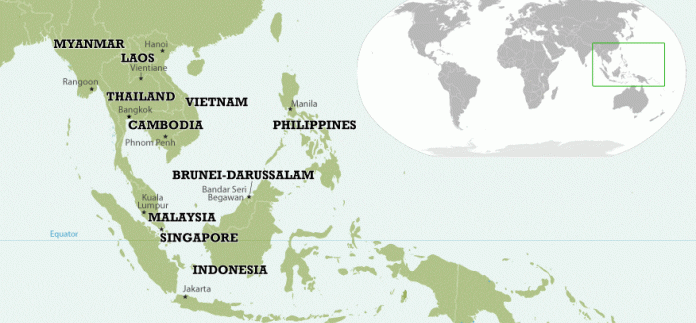
ASEAN’s Sharing Economy: Understanding Opportunities and Navigating Regulations

As internet penetration rates continue to rise in Southeast Asia, ASEAN grows more interconnected by the day.

Home to over 663 million inhabitants, the region is projected by many to be among the world’s most promising markets for a variety of internet based services.

Chief among these are services involved in what has been coined the “sharing economy” – a loose collection of peer-to-peer services known to substantially lower costs for key necessities such as transport and accommodation.

In a 2014 study conducted by Nielsen, Indonesia and the Philippines ranked as two of the top five populations worldwide primed to participate in the sharing economy. While Indonesia ranked second in the study, with 87 percent of respondents reporting a willingness to utilize products within a sharing economy, the Philippines only trailed by two percentage points, earning fourth place Vietnam

Thailand: New KYC Guidelines Issued

Thailand’s central Bank of Thailand (BOT) has introduced new regulations to ease the Know Your Customer (KYC) process using the electronic process (e-KYC) to open accounts on deposit acceptance of funds accepted from the public. Financial institutions globally are increasingly being required to comply with KYC guidelines under the anti-money laundering law (AML). As per the BOT Notification No. SorNOrSor. 7/2559 the following guidelines have been issued.

  • E-KYC procedures must have the same standards as KYC procedures and available only for individual customers using electronic means such as computers, mobile phones, other electronic devices etc. Financial institutions however, must get prior approval from the BOT.
  • Electronic signatures are acceptable.
  • Verification of customers must be done using ID cards or a smart card reader
  • Financial institutions must retain all information including KYC documents or their copies as per the AML law.

The regulation went into effect in August.

Vietnam

As Vietnam increasingly becomes a hub for foreign businesses, the government is streamlining the mergers and acquisitions (M&A) process to encourage investment in new sectors of the economy. While establishing a business in Vietnam may prove too cumbersome for some hopeful entrants, the M&A route provides a unique solution to many of these obstacles. With this path, investors will enjoy preexisting access to consumers, locations, and distribution channels. This local knowledge can prove critical to successful operations within Vietnam’s vibrant but rapidly changing investment environment .

To successfully carry out M&As within Vietnam, it is important to recognize the legal foundation of current policies, and to understand the procedures and limitations associated with acquisitions in Vietnam..

Make a right investment

15/02/2019No comments,